What Fed the Indus: The Archaeobotanical Menu of Harappan Cities
Archaeobotanical evidence from sites like Rakhigarhi reveals how diverse crop rotations and winter-summer harvests sustained the dense populations of the Indus Valley Civilization.

Kavya Sharma for SwavedaJuly 23, 2026
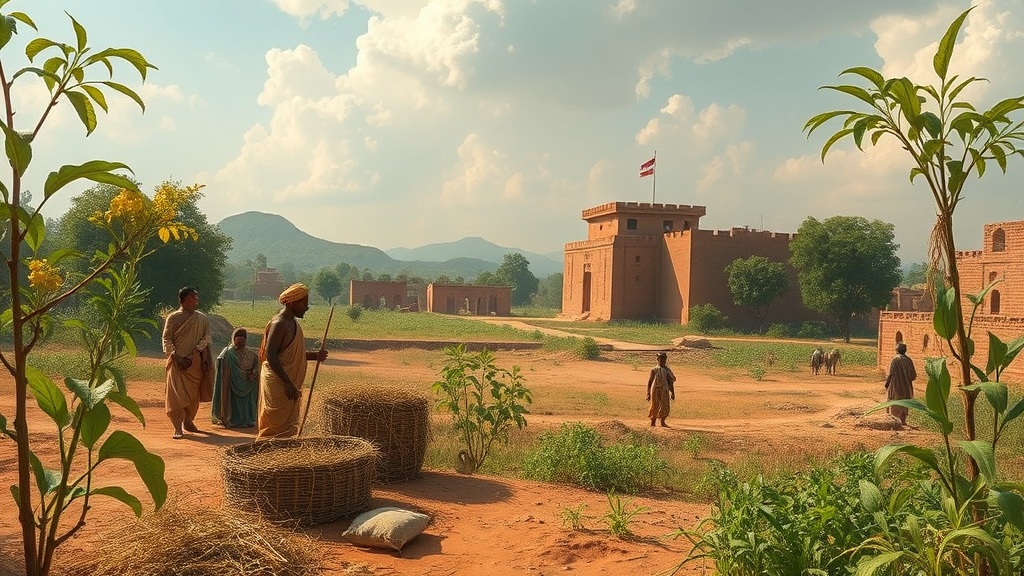
The question of how a sprawling urban civilization functioned often gets lost in discussions of seals and city walls. To understand the Indus Valley Civilization, one must look at the hearth. By examining charred remains found at major sites like Rakhigarhi, researchers have built a picture of a sophisticated agricultural system that relied on more than just a single staple crop.
The Seasonal Strategy
Evidence shows that the Harappans practiced a sophisticated system of multi-cropping. According to research published by Dr. Vasant Shinde and his team, the diet of the people in the Indus Valley was shaped by two distinct agricultural seasons. They cultivated winter crops—known as rabi—such as wheat (Triticum aestivum) and barley (Hordeum vulgare). These crops thrived on the moisture left behind by the receding floodwaters of the Indus River system.
Simultaneously, they managed summer crops—known as kharif—which included various millets. This diversification provided a buffer against environmental instability. If the winter rains failed, the summer harvest provided a backup. Scholars debate the precise influence of climate shifts on these choices, but the archaeobotanical data confirms that a transition toward drought-resistant millets occurred as monsoon patterns evolved over time.
The Menu of the Indus
The Harappan kitchen was remarkably varied. Excavations reveal that the city dwellers were eating a mix of domesticated cereals and legumes. Beyond wheat and barley, findings indicate the consumption of peas, lentils, and chickpeas. These provided essential proteins that, when paired with grains, created a complete nutritional profile for a dense urban workforce.
The presence of millets, specifically foxtail millet and broomcorn millet, is a significant marker in the archaeological record. Unlike wheat, which requires specific irrigation timing, millets are highly resilient. Their cultivation suggests a society that was adapting its agricultural practices to changing water availability. The shift toward these hardy grains is well-documented in the Rakhigarhi excavation reports, which indicate that the inhabitants were not static in their diet, but rather responsive to the environment around them.
From Field to Hearth
What did this look like on a daily basis? Archaeologists use flotation techniques—where soil samples are submerged in water to separate organic debris—to recover these microscopic seeds. These charred remains act as a timestamp for human activity. Because seeds were often burnt in cooking fires or in grain-processing accidents, they survived for millennia in the soil.
The processing of these crops involved tools that remain recognizable today. The use of grinding stones for flour and the development of storage pits for surplus grain were central to the Harappan way of life. This surplus was the engine of their urbanization. Without the ability to store vast quantities of grain, the construction of massive brick structures and the maintenance of complex city layouts would have been impossible.
Tradition holds that these cities were isolated agricultural pockets, but evidence shows a high degree of connectivity. The trade networks that moved lapis lazuli and carnelian also facilitated the movement of botanical knowledge. Seeds were more than just food; they were the most portable form of wealth and technology.
Understanding the Landscape
The reliance on indigenous crops, alongside the integration of winter-sown cereals, allowed the Indus people to avoid the trap of monoculture. By avoiding an over-reliance on a single grain, they mitigated the risks of crop failure caused by pests or localized drought.
While researchers continue to analyze the isotopes in human remains from these sites to pinpoint the exact proportions of these plants in the human diet, the pattern is clear. The Harappans were not merely passive recipients of the monsoon. They were active managers of a complex, bifurcated agricultural cycle. They ate what the land offered, but they also nudged the land to offer more. Through the careful management of soil, water, and seeds, they built a civilization that survived for centuries by ensuring that their storehouses were never empty.
This is the hidden history of the Indus: a story written in the ash of cooking fires and the carbonized remains of seeds. It reminds us that the grandeur of an ancient city is fundamentally built upon the efficiency of its harvest.