Was 'Rajputana' a British Imposition? Tracing a Name Through History
Examining the historical and linguistic origins of 'Rajputana,' this article investigates whether the name predates British rule or was a colonial construct.

Rohan Bhattacharya for SwavedaJune 18, 2026
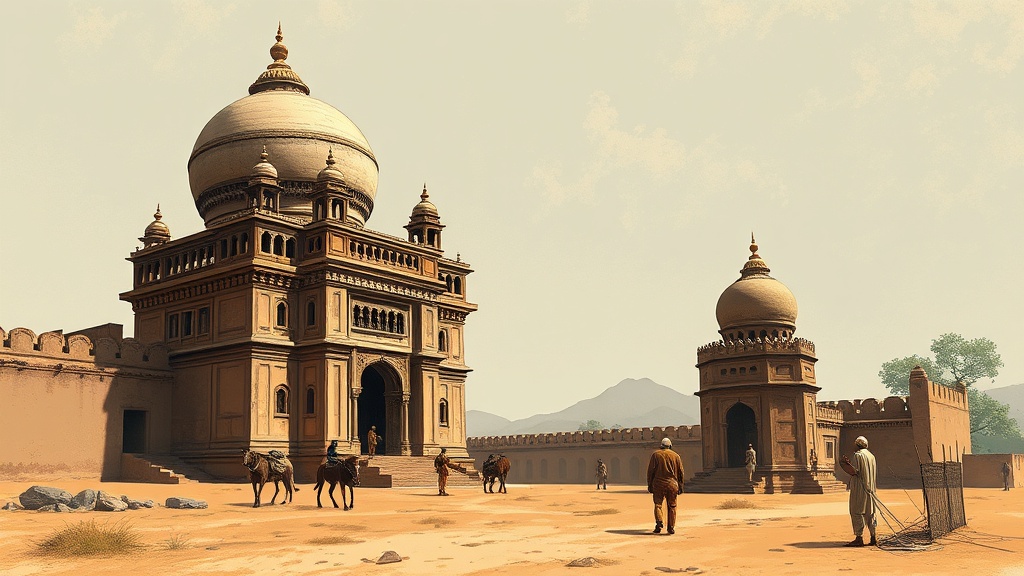
The term 'Rajputana' evokes a distinct region, conjuring images of princely states and martial traditions. But like many regional labels, its origins are not as straightforward as they might appear. A common narrative suggests that 'Rajputana' was a British invention, a convenient administrative label imposed upon a diverse landscape. This article digs into the historical and linguistic evidence to explore the roots of this name, asking whether it truly has pre-colonial antecedents.
The very construction of 'Rajputana' – the suffix '-ana' often indicating a place or territory associated with a particular group – points towards a connection with the Rajputs. The Sanskrit word rājaputra means 'son of a king.' Over centuries, the term evolved to refer to a broad confederation of warrior lineages across parts of northwestern India. The question then becomes: did this association lead to a geographical designation before the arrival of the British?
Historical records offer glimpses. The Ain-i-Akbari, compiled in the late 16th century during the reign of Emperor Akbar, lists various territories within the Mughal Empire. While it details regions and their administrative divisions, it does not consistently use 'Rajputana' as a formal geographical entity. Instead, it refers to individual Rajput kingdoms and territories, such as Mewar, Marwar, and Amber, within larger administrative provinces like Ajmer-Marwara. This suggests that while Rajput power and identity were well-established, a unified territorial name encompassing all their domains was not yet in common usage.
Linguistic shifts provide another layer of understanding. The formation of place names in India has often been an organic process, reflecting local usage, dynastic influence, or linguistic evolution. The '-ana' suffix is not exclusive to British nomenclature. It appears in numerous pre-colonial place names across India, often denoting a territory associated with a dominant clan or ruler. For instance, the term 'Malwa' has ancient roots, but regional variations and suffixes could have emerged over time.
When the British established their administrative presence in the subcontinent, they encountered a complex mosaic of polities. The need for standardized administrative terms and geographical designations became paramount. The region comprising the major Rajput principalities was a significant administrative challenge. The term 'Rajputana' appears with increasing frequency in British administrative documents and maps from the early 19th century onwards.
For instance, reports from the East India Company and subsequent British government archives frequently refer to the 'Rajputana Agency,' established in 1818. This agency was an administrative umbrella formed to manage relations with the numerous Rajput states. The very act of creating an 'Agency' implies a need for a consolidated term to refer to the collection of states. However, this does not definitively prove the name's invention. It could simply reflect an adoption and formalization of a term already in nascent or informal use.
Scholarly debate exists on the precise moment and agency behind the widespread adoption of 'Rajputana.' Some scholars point to the late 18th and early 19th centuries, when British cartographers and administrators began to systematically map and categorize the Indian subcontinent. The practice of naming regions after dominant ethnic or political groups was common globally during this colonial period.
The Archaeological Survey of India (ASI) reports from the period, while detailing excavations and ancient sites, do not typically engage with the etymology of regional names like 'Rajputana.' Their focus remained on material culture and historical periods predating direct colonial administrative structures. Publications such as Ancient India and regional archaeological journals from that era focus on excavation findings rather than the naming conventions of contemporary territories.
It is crucial to distinguish between a name being coined by the British and being formalized and widely popularized by them. Evidence suggests that while the term 'Rajputana' might not have been entirely absent from local discourse or informal usage prior to the 19th century, its systematic application as a distinct geographical and administrative label is closely tied to the British presence. The consolidation of disparate Rajput states under a single administrative umbrella necessitated a unifying designation.
Linguistic analysis of regional dialects and historical land grants from Rajput states prior to the colonial era might reveal earlier instances of the term or its cognates in a territorial sense. However, such evidence is not readily available in mainstream historical accounts or archaeological reports that focus on material remains. The meticulous work of identifying and dating such linguistic usages is an ongoing process in historical linguistics and epigraphy.
In conclusion, the label 'Rajputana' appears to have gained prominence and official status during the British colonial period. While the constituent elements of the name – 'Rajput' and the territorial suffix '-ana' – have roots in Indian history and linguistics, the cohesive regional designation as we understand it today was significantly shaped and formalized by British administrative needs. It is less likely a complete fabrication and more a case of a pre-existing or emergent term being adopted, standardized, and indelibly associated with a specific political and geographical entity by an external power. The strata of history reveal not a sudden imposition, but a gradual layering where colonial administrative practices solidified a regional identity under a specific, enduring name.