The Wild Silks of Nevasa: What Archaeobotanical Residues Reveal About Chalcolithic Deccan Filaments
Microscopic analyses of mineralized thread residues inside Chalcolithic copper beads from Nevasa challenge the narrative of an early Chinese monopoly on silk technology.

Rohan Bhattacharya for SwavedaSeptember 5, 2026
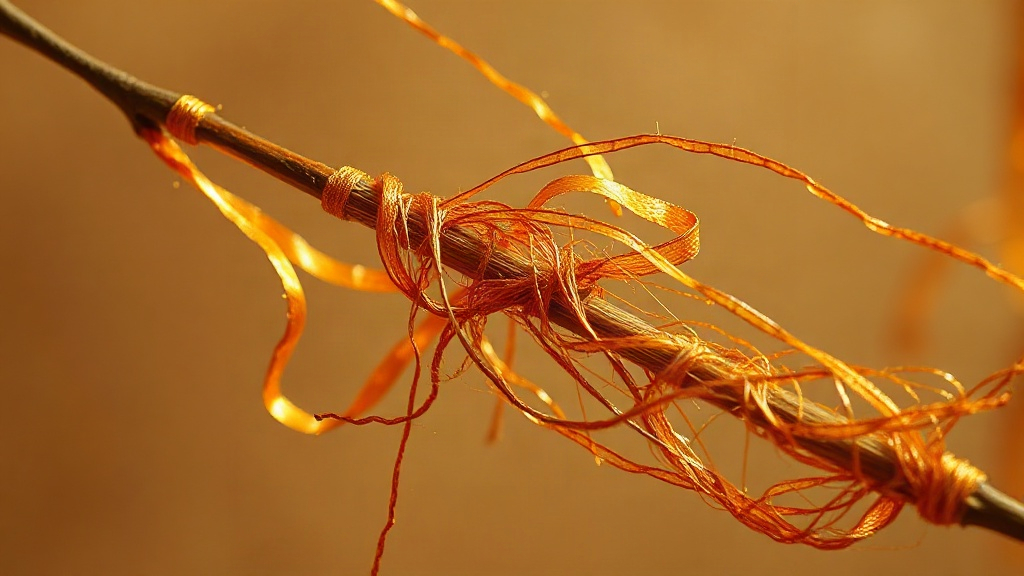
Archaeobotanical investigations in the Deccan region of India have long focused on the recovery of carbonized grains and charcoal to reconstruct ancient agricultural practices. However, some of the most critical clues to the technological capabilities of Chalcolithic (the Copper Age, characterized by the use of stone and copper tools) communities are preserved in micro-stratigraphic contexts. Within the corroded interiors of copper beads excavated from sites like Nevasa in Maharashtra, researchers have identified mineralized thread residues. These microscopic fibers challenge the long-held archaeological assumption that silk production was an exclusive monopoly of early Chinese dynasties during the second millennium BCE.
During the excavation of Chalcolithic layers at Nevasa, archaeologists recovered copper beads containing preserved metallic thread fragments. When copper corrodes in archaeological soils, it releases copper salts that act as biocide agents. These salts kill the microorganisms that would otherwise digest organic materials, replacing the organic structures with inorganic minerals. This preservation process, known as mineralization, leaves behind a perfect physical cast of the original organic fiber. Under scanning electron microscopy (SEM), researchers can observe the surface morphology, cross-sectional shapes, and micro-structures of these ancient threads.
In Indian archaeology, dating disputes often hinge on the contextual integrity of such micro-samples. The Chalcolithic layers at Nevasa, characterized by Jorwe-style pottery (a distinctive painted ceramic tradition of the Deccan), are generally dated from approximately 1500 BCE to 1050 BCE. The discovery of these fibers within undisturbed stratigraphic contexts suggests that early Indian communities were harvesting and processing silk filaments concurrently with, or independent of, early Chinese silk production.
The critical distinction lies in the species of silkworm utilized. The dominant narrative of early silk history centers on Bombyx mori, the domesticated silkworm of China, which feeds exclusively on mulberry leaves. Bombyx mori silk is characterized by its smooth, uniform, and round thread structure, which is easily reeled from the cocoon after boiling.
By contrast, the mineralized fibers analyzed from Nevasa exhibit distinct morphological features that align with wild silk species native to South Asia, such as Antheraea (which produces tussar silk) and Philosamia (which produces eri silk). Under high-magnification SEM analysis, these wild silk fibers show a flattened, ribbon-like cross-section and prominent longitudinal striations. These morphological markers are absent in domesticated Bombyx mori silk.
Evidence shows that the Chalcolithic inhabitants of the Deccan did not domesticate these silkworms. Instead, they practiced a form of wild harvesting. This involved collecting cocoons from local forest trees, such as Terminalia, after the moths had already emerged. Because the emerged moths break through the cocoon shell, the continuous filament is severed into short, broken strands.
To process these damaged cocoons, Chalcolithic artisans had to employ a spinning technique rather than the traditional reeling method used for intact Bombyx mori cocoons. The presence of spun wild silk threads inside the Nevasa copper beads indicates a highly developed regional textile technology. The artisans degummed the wild silk cocoons using alkaline solutions, likely made from wood ash, to soften the tough sericin (the natural gum that binds silk fibers). Once softened, the short fibers were spun using simple terracotta whorls, which are frequently recovered from Jorwe-period occupational deposits.
The implications of these wild silk residues are discussed in archaeological journals, including reports in Antiquity and publications by the Archaeological Survey of India (ASI). Rather than representing an import from East Asia, the Nevasa silk points to an indigenous, independent origin of sericulture. This wild silk technology operated without the complete domestication of the insect host.
Scholars debate the extent to which this wild silk technology was distributed across other Chalcolithic sites in the Deccan and the Ganga valley. While similar mineralized threads have been reported at Chalcolithic sites like Chandoli, the lack of systematic SEM analysis on metal bead assemblages across many older excavations limits our understanding of the geographic range of this industry. Many early excavations did not preserve metal artifacts in conditions suitable for micro-organic analysis, or the internal residues were cleared during aggressive conservation cleaning in laboratory settings.
Future micro-stratigraphic studies of uncleaned copper beads from museum collections may reveal a broader network of wild silk production in Chalcolithic India. For now, the physical evidence preserved in the mineralized layers of Nevasa demonstrates that the technology of extracting, spinning, and utilizing silk filaments was well established in the Deccan by the mid-second millennium BCE. This ancient industry relied entirely on the exploitation of the local forest ecology.