The Weight of the Aureus: What the Akkenapally Hoard Reveals About Satavahana Bullion Standards
An analysis of slashed Roman gold coins from the 1959 Akkenapally hoard reveals how the Satavahana dynasty integrated foreign imperial currency into local Deccanese weight standards.

Devika Menon for SwavedaAugust 17, 2026
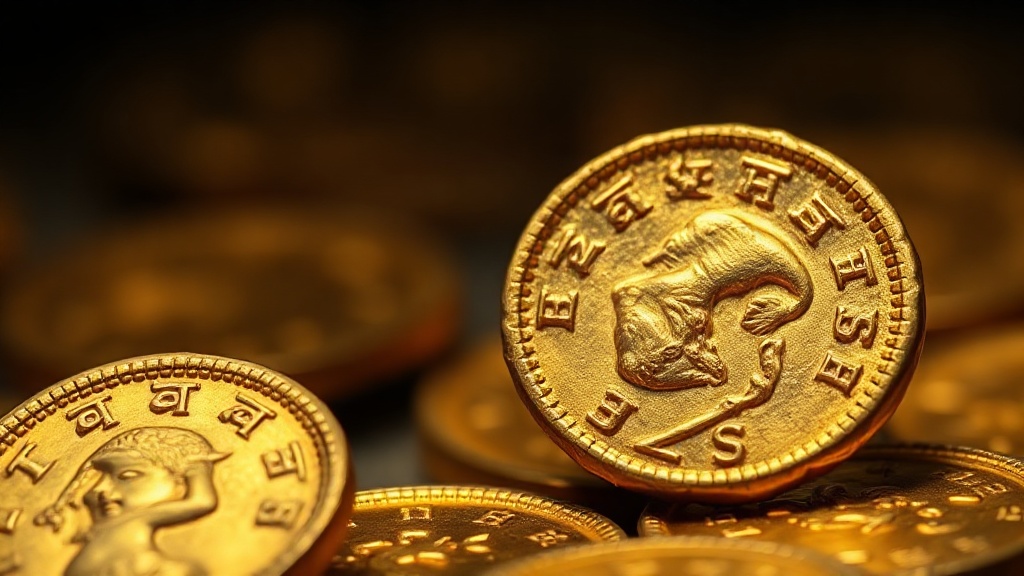
In 1959, agricultural laborers in Akkenapally village, located in the Nalgonda district of Telangana, uncovered a terracotta vessel buried in the soil. Inside lay a cache of ancient coins: 153 Roman gold aurei (singular aureus, the standard Roman gold coin) and a single silver coin of the local Satavahana dynasty, which ruled the Deccan plateau from approximately the second century BCE to the third century CE.
To a casual observer, the find might suggest a simple hoard of imported wealth, preserved intact from the lucrative maritime trade between the Roman Empire and India. Yet, a closer inspection of the physical coins reveals a more complex economic reality. Nearly all the gold coins in the Akkenapally hoard bear deliberate, deep slash-marks across the imperial portraits.
For decades, historians debated the meaning of these defaced coins. A common traditional view held that early Indian kingdoms viewed Roman coins purely as prestige items, jewelry, or exotic bullion. However, physical evidence from the Akkenapally hoard challenges this perspective. Instead, the precise mutilation of these aurei indicates that the Satavahana state actively intervened in the circulation of foreign gold, using slash-marks to systematically counterstrike, verify, and integrate Roman coins into local weight and monetary standards.
The Physical Evidence of Mutilation
The Akkenapally hoard is not an isolated phenomenon. Similar slashed Roman coins have been documented across the Indian peninsula, notably in the Eyyal hoard in Kerala and various sites in Tamil Nadu. What makes the Akkenapally collection distinct is the uniformity of the defacement.
The slashes are not random scratches. Numismatic analysis shows that the incisions are clean, deliberate cuts made with a chisel or a sharp blade. In most cases, a single horizontal or diagonal slash runs directly across the face of the reigning Roman emperor—frequently depicting Tiberius (who ruled from 14 to 37 CE) or Augustus (who ruled from 27 BCE to 14 CE).
Scholars initially interpreted this defacement as an act of political protest or a symbolic rejection of Roman imperial authority. This theory, however, fails to explain why merchants would deface precious metal if they merely wished to destroy its political value. Gold carries intrinsic value. A symbolic gesture would not justify the labor required to deface hundreds of individual coins.
A more practical explanation lies in the economics of ancient metallurgy. The slash served a dual functional purpose: it acted as an assay cut to test the purity of the metal, and it cancelled the coin's status as official foreign currency. By slicing through the emperor's portrait, Satavahana authorities or elite guild merchants (shrenis, merchant cooperatives) demonstrated that the coin was no longer recognized as a legal tender of Rome. Instead, it was reduced to a certified piece of pure gold bullion, valued strictly by its weight.
Aligning the Aureus with Deccan Weight Standards
To understand why the Satavahanas deactivated the nominal value of the aureus, one must look at the prevailing weight systems of the Deccan.
The Roman aureus of the early empire weighed approximately 7.8 grams. During the reign of Nero (who ruled from 54 to 68 CE), the Roman state debased its currency, reducing the weight of the aureus to about 7.3 grams. This change created an influx of older, heavier pre-Neronian gold coins into foreign trade routes, as Indian merchants preferred the higher gold content of the earlier issues.
The Satavahana monetary system did not historically rely on a native gold coinage. The dynasty primarily minted coins in lead, copper, potin (an alloy of copper, tin, and lead), and occasionally silver. Their silver issue, the karshapana (a standard ancient Indian coin weight unit), adhered to a local weight standard of approximately 3.5 grams.
By slashing the aureus, local authorities prepared the foreign gold to be traded alongside local metals. Because the aureus did not fit neatly into the karshapana standard, it had to be weighed and valued as raw metal. The slash-mark guaranteed to local traders that the coin was solid gold throughout, preventing the circulation of plated counterfeits (known as subaerati, bronze-cored coins covered with a thin layer of gold or silver).
The presence of a single silver Satavahana coin in the Akkenapally jar, bearing the portrait of King Vashishtiputra Pulumavi (who ruled in the second century CE), supports the theory that these gold coins were stored alongside local currency for domestic economic transactions, rather than being kept as untouchable royal heirlooms.
Maritime Trade and the Periplus
The economic link between Rome and the Deccan is well-documented in primary geographical texts. The Periplus Maris Erythraei (The Periplus of the Erythraean Sea), a Greek maritime travelogue written by an anonymous merchant in the mid-first century CE, explicitly mentions the ports of the western Indian coast.
The text notes that Roman gold and silver coin (denarius) was imported into coastal markets such as Barygaza (modern Bharuch) and Muziris. According to the author of the Periplus, this foreign currency was traded at an advantage against local money. This "advantage" likely refers to the premium value of high-purity gold when converted into local base-metal currencies like the lead and potin coins of the Satavahanas.
Inscriptions in the Western Ghats caves, such as those at Nasik and Junnar, further corroborate the integration of Roman gold into the local economy. Several inscriptions record donations made by merchants and royals in kushanas or suvarnas (local terms for gold denominations). The physical presence of slashed aurei at Akkenapally suggests that these "gold denominations" were often actual Roman coins that had been vetted, marked, and repurposed by local authorities to function as standardized bullion.
Rather than circulating in a separate, isolated economy of luxury prestige, the mutilated coins of the Akkenapally hoard demonstrate that the Satavahana state possessed a highly organized system of monetary control. Through the simple act of a chisel stroke, the ancient Deccan kingdoms tamed the currency of the Mediterranean, converting the face of Rome's emperors into a predictable, trusted local commodity.