The Weaver’s Shuttle in the Rigveda: What the Word 'Otu' Reveals About Bronze Age Textile Exchange
A linguistic and archaeological look at the Rigvedic weaving term 'ōtu' and its potential Dravidian origins, shedding light on Bronze Age technology transfer in the ancient northwestern subcontinent.

Asha Naidu for SwavedaOctober 3, 2026
In the sixth mandala (book) of the Rigveda (an ancient collection of Sanskrit hymns), the poet Bharadvaja poses a series of cosmic riddles. Struggling to comprehend the mystical architecture of a sacrifice, he turns to a metaphor that would have been instantly recognizable to his listeners. He sings, "I do not know the warp nor do I know the woof, nor that which they weave in the gathering" (Sanatana Dhara).
For the warp (the lengthwise threads attached to a loom), the poet uses the inherited Indo-European term tantu (thread or warp). For the woof (the crosswise threads woven through the warp by a shuttle), however, he uses the word ōtu (woof or weft) (Quora). While tantu has clear cognates in other Indo-European languages, the etymology of ōtu has led historical linguists into a deep and complex investigation of linguistic borrowing and technological transfer in Bronze Age India.
Tracking the Etymology of Otu
To understand how words travel, linguists look for cognates, which are words in different languages that share a common ancestral form. The Sanskrit word tantu derives from the Proto-Indo-European root meaning "to stretch" or "to spin," with cousins in Latin and Germanic tongues. But ōtu has no clear cognates in other Indo-European branches (Scribd).
In his landmark comparative study of the Sanskrit language, the British philologist Thomas Burrow listed ōtu as a technical term that likely originated from a non-Indo-Aryan source (Internet Archive). Linguistic evidence shows that early Sanskrit speakers adopted local vocabulary when encountering new flora, fauna, and specialized artisanal trades in the northwestern subcontinent (Wikipedia).
Linguists have pointed to Proto-Dravidian, the reconstructed ancestor of modern southern Indian languages like Tamil and Kannada, as a probable source. According to the Dravidian Etymological Dictionary compiled by Burrow and Murray B. Emeneau, the Proto-Dravidian root *ōtu or *ōdu carries the meaning of "to weave, run a thread, or slide" (Internet Archive) (Reddit). The action refers directly to the movement of a shuttle sliding back and forth across the warp. If early Sanskrit speakers adopted the physical shuttle or the specific style of loom from Dravidian-speaking counterparts, they likely adopted the technical verb describing the action of the weft thread crossing the loom.
⚖ Scholarly Debate: Indo-Aryan and Dravidian Contact
The presence of Dravidian loanwords in the Rigveda is a key piece of data in a wider, ongoing debate about the prehistory of South Asia.
Tradition holds, in many orthodox Indian accounts, that Vedic Sanskrit and Indo-Aryan culture are indigenous to the subcontinent, developing directly from the earlier Indus Valley Civilization. Scholars who support this Out-of-India model argue that any linguistic overlaps are either coincidental or reflect a native development within a single, highly diverse ancient population (Shrikant G Talageri).
Conversely, modern historical linguistics and archaeological models suggest that Indo-Aryan speakers migrated into northwestern India from Central Asia during the early second millennium BCE (Wikipedia). In this scenario, the migrating pastoralists encountered established agricultural populations speaking Dravidian or Austroasiatic languages (Britannica). The borrowing of a highly technical, home-based manufacturing term like ōtu suggests that this interaction was not merely hostile or superficial, but involved deep, cooperative household exchanges where crafts like weaving were taught and shared.
The Archaeology of Bronze Age Loom Technology
This linguistic exchange does not exist in a vacuum; it is physically grounded in the soil. Unlike pottery or bronze axes, organic textiles quickly rot in the warm, seasonal climate of the Indian subcontinent (Science News). However, archaeologists have recovered direct evidence of a highly developed textile tradition in the Indus Valley and subsequent Late Harappan sites.
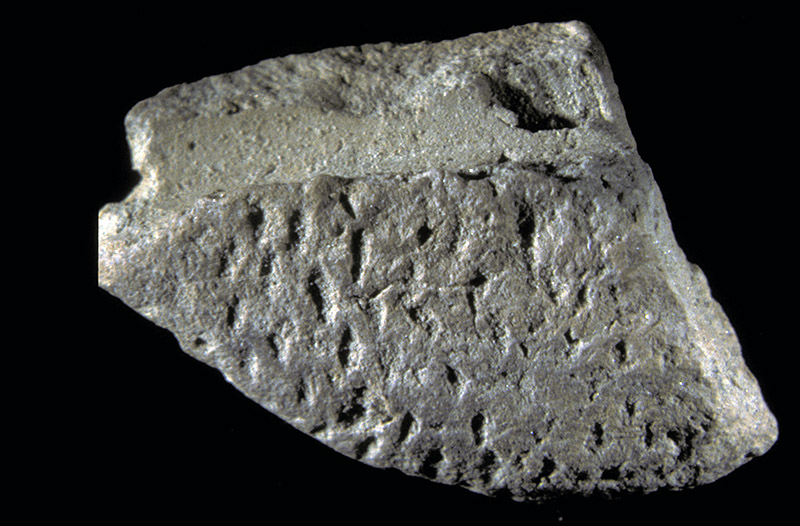
Excavations at Harappa and Mohenjo-daro have yielded thousands of terracotta spindle whorls (weighted discs used to spin thread) and specialized bone tools (Harappa) (Rebus Press). Furthermore, impressions of woven cotton fabric have been found preserved on the interior of pottery fragments and clay beads dating as far back as 3300 BCE (Harappa).
By the Late Harappan period (roughly 1900 BCE to 1300 BCE), as the large urban centers of the Indus Valley declined and populations shifted eastward into the Punjab and the Ganga-Yamuna Doab (the tongue of land between the Ganga and Yamuna rivers), weaving technology remained a vital household industry (NCERT). The looms used in this region were likely warp-weighted looms or simple horizontal ground looms. In both cases, weaving requires a deliberate separation of the warp threads to allow the weft, carried by a shuttle, to slide cleanly across.
When early Indo-Aryan communities integrated into this landscape, they brought their own pastoral traditions but adapted to the agricultural and artisanal systems of the region. The linguistic evidence suggests they did not merely purchase finished cloth; they learned the trade. By adopting the Dravidian word *ōtu to describe the weft, they preserved a record of the precise moment the shuttle passed from one pair of hands to another.
A Legacy Woven in Wood and Bone
The Rigvedic weavers, both men and women, worked in a world where technology and ritual were deeply intertwined. The hymns frequently compare the performance of a sacrifice to the weaving of a garment, stretching the threads across the loom of the sky.
In tracing the etymology of ōtu, we catch a glimpse of the real, domestic interactions that built ancient Indian society. It shows us that while languages can clash and shift, the vocabulary of everyday creation—of spinning, sliding the shuttle, and binding the thread—possesses a unique resilience, leaving an indelible mark on the oldest texts of the subcontinent.
Sources and Further Reading
- Prabuddha Bharata: Dress and Ornaments of Ancient Times
- Sanatana Dhara: Rishi Bharadvaja and Rigvedic Metaphors
- Thomas Burrow: The Sanskrit Language (Third Edition, 1973)
- Harappa.com: Textile Impressions on Ancient Beads
- Rebus Press: Craft Technologies of the Indus Civilization
- NCERT: Bricks, Beads and Bones - The Harappan Civilisation
- Burrow & Emeneau: Dravidian Etymological Dictionary
- Wikipedia: Substratum in Vedic Sanskrit