The Superintendent of Slaughterhouses: Administrative Realities in the Arthashastra
The Arthashastra suggests the Mauryan state regulated meat consumption rather than banning it, reflecting an administration that balanced religious shifts with fiscal oversight.

Asha Naidu for SwavedaJuly 17, 2026
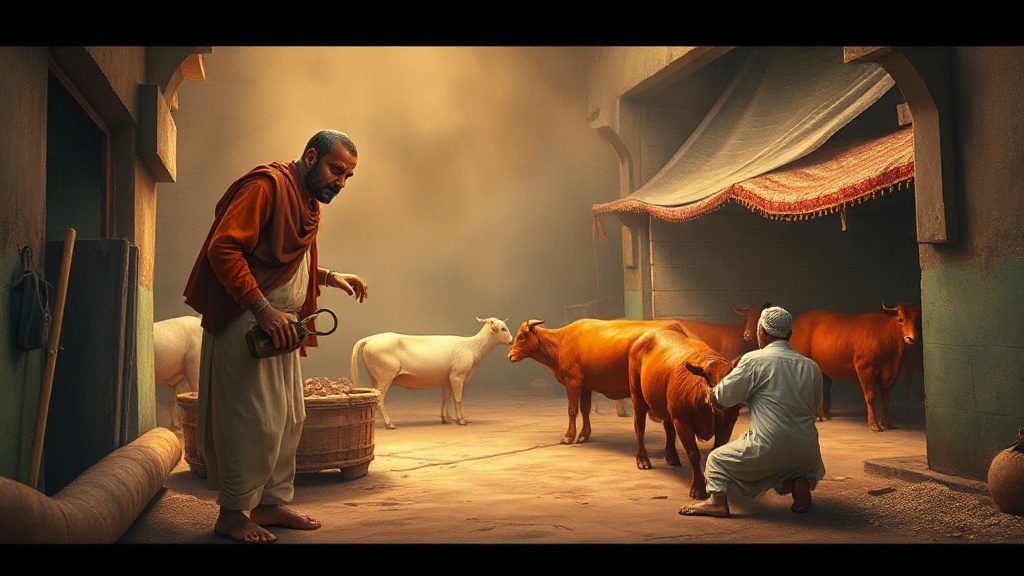
The word Sunadhyaksha emerges from the Sanskrit components sunā (slaughterhouse) and adhyaksha (superintendent or overseer). In the Arthashastra, the foundational administrative treatise attributed to Kautilya, this official was not merely a manager of a facility. He functioned as a regulatory authority at the intersection of public hygiene, state revenue, and the dietary sensibilities of the citizenry.
It is necessary to note at the outset that the composition of the Arthashastra is a subject of intense scholarly debate. While some attribute the text to the 4th-century BCE minister of Chandragupta Maurya, others, such as Thomas Trautmann, have argued through statistical and linguistic analysis that the text is a multi-layered work likely compiled between the 2nd century BCE and the 2nd century CE. Regardless of its exact dating, the text provides a window into the administrative logic of the period.
The presence of this office offers a necessary correction to contemporary debates regarding the status of meat consumption in early Indian history. While tradition holds that non-violence—ahimsa (non-injury to living beings)—was the singular moral trajectory of the period, evidence shows that the state engaged in the systematic management of the meat trade rather than its wholesale prohibition.
The Mandate of the Sunadhyaksha
Kautilya’s text outlines specific duties for the Sunadhyaksha that suggest a highly structured market. The superintendent was responsible for overseeing the sale of flesh, ensuring that meat was sold only after the animal was freshly slaughtered. He was tasked with collecting a fixed fee from those authorized to slaughter animals, often identified as a shulka (duty or tax).
Scholars debate the extent to which these regulations were designed for sanitary control versus economic extraction. According to Patrick Olivelle’s analysis, the Arthashastra records that the superintendent was to inspect meat for impurities and manage the flow of livestock into the urban centers. This administrative logic implies that the consumption of meat was an accepted, albeit regulated, feature of the economy, rather than a clandestine or illicit practice.
Balancing Belief and Bureaucracy
Recent historical discussions highlight the tension between the rise of Jain and Buddhist philosophies—which emphasized vegetarianism—and the practical requirements of a sprawling imperial bureaucracy. As Patrick Olivelle notes in his comprehensive study of the text, the influence of ascetic traditions did not instantaneously transform the entire food system of the subcontinent.
The Arthashastra provides evidence that the state acted as a mediator. By establishing rules for the operation of slaughterhouses, the administration acknowledged that the urban demand for meat remained consistent. The state did not prohibit the activity; it institutionalized it. This suggests that the administration practiced a form of pragmatic pluralism. They were aware of the shifting religious values—perhaps even sympathetic to them—yet they maintained the fiscal and logistical infrastructure required to serve a populace with diverse dietary habits.
Legal Precedents and Prohibitions
The Arthashastra does detail specific prohibitions, such as the ban on slaughtering certain animals, including protected species or those with religious significance, within the city limits. However, the existence of a Sunadhyaksha confirms that the act of slaughtering was, in itself, a sanctioned administrative function.
These regulations were rarely absolute; they were selective. A distinction was made between animals fit for consumption and those afforded state protection. This nuance is critical for understanding the society described in the text. It was not a binary environment where one was either a vegetarian or an outlaw. Instead, it was an environment defined by legal categories, where the state determined what was permissible through the oversight of the Sunadhyaksha.
Administrative Logic vs. Modern Interpretations
Modern attempts to project contemporary dietary values onto the past often ignore the specific administrative functions described in primary sources. By treating the Arthashastra as a mirror of modern political debates, observers often miss the granular reality of how the state actually functioned.
The Sunadhyaksha was an instrument of the state’s desire for order. In a large kingdom, the ability to control the supply of meat was an expression of power. It allowed the government to exert influence over market prices, ensure the quality of food, and extract revenue for the royal treasury. This was an economic necessity, not a moral vacuum.
As we examine the historical record, it is clear that the approach was one of containment and regulation. The Sunadhyaksha managed a trade that had deep roots in the region, adapting to the moral pressures of the era without dismantling the economic structure that underpinned the state. Understanding this office helps clarify that the history of the Indian diet is one of complexity, where state policy, religious shift, and economic reality occupied the same administrative space.
By analyzing the specific duties of the Sunadhyaksha, we move away from generalizations and toward a more accurate portrayal of how early states navigated the varied needs of their subjects. The Arthashastra remains a vital lens for seeing this balance in action, proving that the state’s primary concern was the management of a society that was far more heterogeneous than singular, morality-based narratives would have us believe.