The Stratigraphy of Sanghol: What Punjab's Bara-Culture Ash Lenses Reveal About the Post-Harappan Transition
A detailed look at the overlapping ceramic styles and ash-lens deposits at Sanghol in Punjab, challenging the idea of a sudden post-Harappan collapse in favor of a complex cultural co-existence.

Rohan Bhattacharya for SwavedaAugust 7, 2026
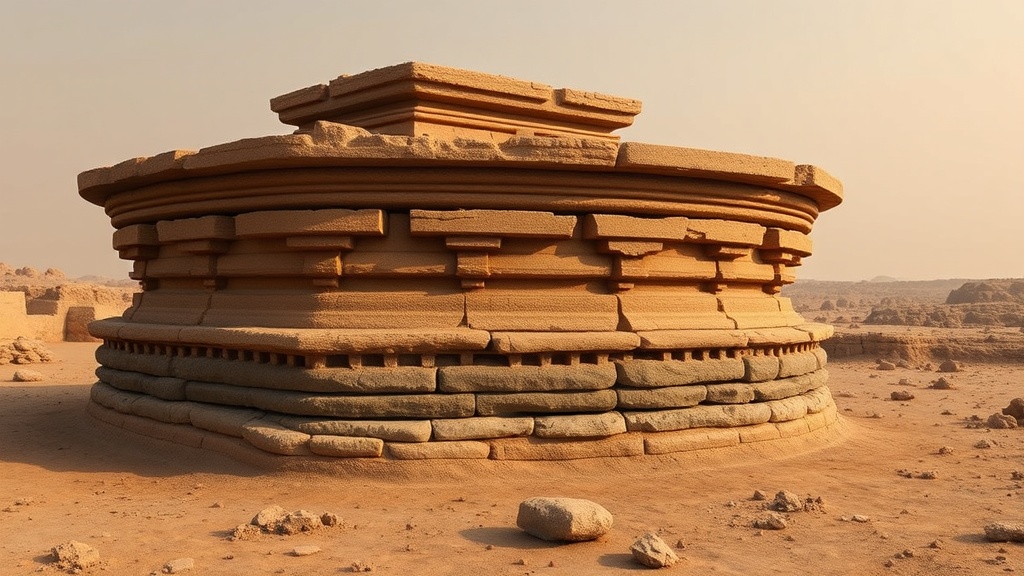
For archaeologists who prefer the slow testimony of soil layers to the grand narratives of sudden conquest or total collapse, the mound at Sanghol in the Ludhiana district of Punjab is a critical reference point. Excavations conducted there by the Archaeological Survey of India (ASI) have long challenged the traditional, linear view of the post-Harappan transition. Instead of showing a sudden replacement of the Indus Valley Civilization by incoming groups, the stratigraphy (the study of rock and soil layers) of Sanghol reveals a complex, overlapping sequence where distinct ceramic traditions co-existed over centuries.
To understand this transition, archaeologists look to the sequence of cultural layers preserved in the earth. In regional excavation reports published in Puratattva (the bulletin of the Indian Archaeological Society) and the memoirs of the ASI, Sanghol is documented as a key site for studying the Bara culture. The Bara culture is named after the type-site of Bara near Ropar, which features a ceramic tradition characterized by heavy, incised slip ware (pottery coated with a liquid clay wash before firing) and distinct organic decoration.
For decades, scholars have debated whether the Bara culture was a precursor to, a contemporary of, or a successor to the Harappan civilization. The physical evidence at Sanghol offers a clear stratigraphic answer to this dating dispute.
Reading the Layers of Sanghol
At Sanghol, the lowest inhabited levels reveal a fascinating overlap. According to reports in Man and Environment (the journal of the Indian Society for Prehistoric and Quaternary Studies), the early occupational phase does not present a neat, sterile boundary between Late Harappan and Bara deposits. Instead, excavation trenches show a physical interdigitation—interlocking finger-like layers—of Late Harappan red ware and Bara incised pottery.
This indicates that the two distinct cultural groups did not merely succeed one another in a clean chronological break. Evidence shows that they inhabited the same regional landscape, trading materials and technological styles.
The physical matrix of this transition is recorded in the soil itself. Rather than a thick layer of burnt debris or abandoned structures, which would suggest a violent end to the Harappan occupation, the stratigraphy reveals a series of thin ash-lens (flat, pocket-like deposits of ash and charcoal) sequences. In field archaeology, these ash lenses represent localized, domestic hearths (fireplaces) or small-scale refuse pits.
These layers of ash and charred organic matter suggest continuous, low-intensity occupation. The analysis of these deposits shows that as the classic urban planning of the Harappans decayed, the site was not abandoned. Instead, Bara-culture ceramic techniques gradually became the dominant style in the upper layers, while Late Harappan forms slowly faded out.
The Significance of the Bara Ceramics
The transition is most clearly visible in the evolution of pottery styles found within these stratigraphic layers. Classical Harappan pottery is known for its standardized, plain wheel-made shapes and black-painted botanical designs on a red slip. In contrast, Bara pottery is more diverse, featuring incised geometric patterns, rusticated (roughened) lower bodies, and a distinct dull-red to orange slip.
In papers published in Antiquity, researchers have noted that the Bara pottery at Sanghol is not a crude imitation of Harappan ware. It represents a highly sophisticated, independent ceramic tradition. The presence of both styles within the same occupational layers suggests that local potters were sharing techniques. This ceramic overlap directly challenges the older "invasion" or "sudden collapse" models of South Asian protohistory.
The evidence from Sanghol shows that the decline of the larger Harappan urban centers led to a ruralization of the landscape. During this phase, regional cultures like the Bara emerged as resilient, localized adaptations.
⚖ Scholarly Debate: Who Were the Bara People?
While the physical stratigraphy at Sanghol clarifies the gradual nature of the material transition, the linguistic, genetic, and ethnic identities of these late-phase populations remain highly contested. Scholars debate how these physical layers map onto the wider protohistoric movements in South Asia.
One prominent school of thought, aligned with traditional historical-linguistic models, suggests that the Late Harappan and Bara cultures represent the material remnants of indigenous, non-Indo-Aryan speaking populations undergoing a period of localized, climate-driven de-urbanization. In this view, the gradual decline of the urban Harappan centers allowed regional agro-pastoral groups, like the Bara culture, to expand. According to these scholars, any migration of Indo-Aryan speakers (associated with the Vedic literature) occurred later, during the subsequent Painted Grey Ware (PGW) phase, meaning the Bara-Harappan overlap is entirely internal to the post-Indus world.
Conversely, another group of scholars and archaeologists argues for a much earlier and more integrated transition. They propose that the stylistic shifts and overlaps seen in the Bara ceramics indicate a long-term, peaceful assimilation of newly arriving Indo-Aryan groups with the existing Late Harappan populations. Under this model, the "transition" was not a sudden replacement but a centuries-long process of cultural synthesis, where the material culture of the Bara represents a hybrid community where language and technology were actively being exchanged.
Beyond the Linear Narrative
The detailed archaeological record at Sanghol cautions against using broad brushstrokes to describe the end of the Indus Valley Civilization. Scholars debate the precise linguistic and ethnic identities of the creators of these cultures, but the physical artifacts demand a focus on material continuity.
Rather than a sudden cultural vacuum filled by new migrations, the soil of Punjab preserves a story of gradual adaptation. The ash lenses, the overlapping pottery in the trenches, and the absence of a catastrophic destruction layer all point to a slow, evolutionary transition. For the field archaeologist, the true history of the Harappan-Arya transition is not written in grand epic battles, but in the quiet, dusty accumulation of household hearths and discarded pottery shards at sites like Sanghol.
Sources and Further Reading: