The Stratigraphy of Pork: What Pig Husbandry at Masudpur I Reveals About Early Harappan Village Economies
A re-examination of faunal remains at the Early Harappan site of Masudpur I in Haryana challenges models of uniform pastoralism, revealing localized pig husbandry that sustained ordinary households.

Rohan Bhattacharya for SwavedaAugust 28, 2026
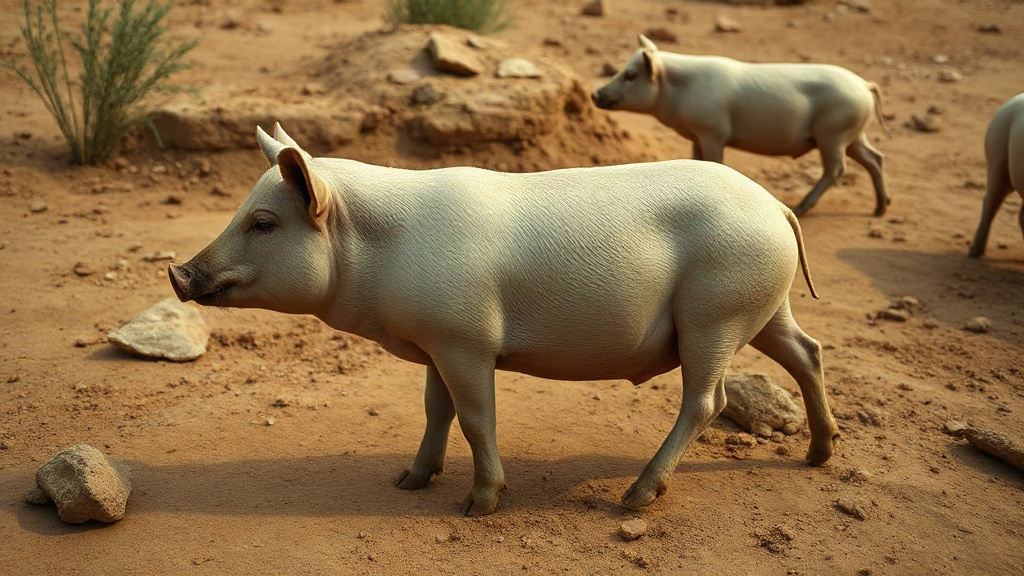
For decades, the standard narrative of the Indus Valley Civilisation has focused on the grand scale of its urban planning, its standardized brick sizes, and its long-distance trade networks. In these accounts, the economy of the plains is often described in broad, uniform strokes. Cattle (Bos indicus) and sheep or goats (Ovis/Capra) dominate the faunal assemblages—the collections of animal bones recovered from archaeological digs. This pastoral model suggests a highly mobile, elite-driven system of livestock management designed to feed growing cities.
However, a closer look at the stratigraphy—the analysis of soil and debris layers—at smaller rural settlements reveals a far more complex picture of local survival. At Masudpur I, a small site located in the Hisar district of Haryana, the archaeological record tells a different story. Here, during the transition from the Early Harappan to the Mature Harappan phase, the bones of the domestic pig (Sus scrofa) emerge not as a rare anomaly, but as evidence of a highly localized, household-level economy.
This domestic pig husbandry challenges the idea of a centralized, uniform Harappan agricultural strategy. Instead, it reveals how ordinary households managed their own food security independent of urban centers.
The Layers of Masudpur I
Masudpur I is one of several small, rural settlements excavated as part of the Joint Indus Project, a collaborative archaeological venture between the Deccan College Post-Graduate and Research Institute and the University of Cambridge, with support from the Archaeological Survey of India. Published excavation reports in journals like Man and Environment and the memoirs of the Indian Archaeological Society have detailed the site's occupational sequence.
Unlike the massive urban centers of Harappa or Mohenjo-daro, Masudpur I was a modest village, measuring less than two hectares. The stratigraphy of the site spans the late fourth millennium BCE to the early third millennium BCE, capturing the crucial transition from the regional, pre-urban cultures to the integrated urban network of the Mature Harappan period.
During excavations led by researchers such as Ravindra N. Singh and Cameron A. Petrie, archaeologists uncovered a sequence of hearths, refuse pits, and mud-brick structures. It is within these domestic contexts—specifically the refuse pits adjacent to small dwellings—that the faunal remains were recovered. Rather than showing a sudden shift toward the cattle-dominated economy typical of mature urban centers, the lower strata of Masudpur I yielded a significant proportion of pig bones.
Sifting the Faunal Evidence
In Indian archaeology, identifying pig remains requires extreme care. Distinguishing between the wild boar (Sus scrofa cristatus) and the domestic pig (Sus scrofa domesticus) relies on osteological analysis—the study of bones—specifically looking at the size of the third molars and the age-at-death profile of the animals.
In reports published in Puratattva and Antiquity, faunal analysts have noted that a high percentage of the pig bones at Masudpur I belonged to juvenile or sub-adult animals. In a hunting economy, wild boars are typically killed at mature sizes to maximize meat yield and avoid the dangers of hunting young, fiercely protected animals. A high proportion of juvenile bones, by contrast, is a classic marker of domestication. It indicates that humans were controlling the herd, culling younger males for food while keeping breeding females alive.
Furthermore, the anatomical distribution of the bones is telling. Archaeologists found cranial fragments, teeth, and lower limb bones scattered within domestic waste layers. In a system where meat is traded over long distances, one expects to find "high-value" cuts—like the femur or humerus—at consumption sites, while the "low-value" waste from butchery remains at the slaughter site. The presence of all skeletal elements at Masudpur I indicates that pigs were born, raised, butchered, and consumed within the immediate vicinity of the households.
The Economics of the Backyard Pig
To understand why the villagers of Masudpur I kept pigs, one must look at the environmental and economic realities of the Haryana plains during the Early Harappan phase. Cattle and water buffalo require vast grazing lands and significant water supplies. They are investments in long-term wealth, used for milk, traction (pulling carts or ploughs), and eventual slaughter.
Pigs, however, are highly efficient trash converters. They reproduce rapidly, have large litters, and can survive on household scraps, crop byproducts, and wild forage. Unlike cattle, which require communal pasture management, pigs can be kept in small backyard pens or allowed to scavenge around the edges of a village.
Scholars debate the social status of pig keepers in protohistoric India. While some later historical texts view the pig with disdain, the archaeological evidence from the Indus age suggests that pig husbandry was a pragmatic, household-level insurance policy. During periods of erratic rainfall or agricultural stress, a family with a few pigs had a reliable source of protein that did not depend on communal grazing rights or regional trade networks.
This localized strategy suggests that the early Indus economy was not a monolith. While the emerging elites of the larger towns may have focused on prestige pastoralism—raising cattle for trade and status—the residents of Masudpur I relied on a mixed strategy. They grew barley and winter pulses, kept a few cattle, and supplemented their diet with household pig husbandry.
Challenging the Uniform Model
The discoveries at Masudpur I caution against relying on broad generalizations in South Asian archaeology. For years, the dominance of cattle bones at major urban sites led to the assumption that all Harappan settlements followed the same pastoral trajectory.
The stratigraphy of Masudpur I reveals that rural communities maintained their own distinct economic traditions. Even as the region began to integrate into the wider Mature Harappan economic sphere, the everyday practices of the village remained grounded in local ecology. The humble pig, long overlooked in discussions of Harappan sophistication, serves as a reminder that the foundations of India's earliest urban civilization were built upon diverse, resilient, and highly localized village economies.