The Stratigraphy of a Caste-Mixed Hearth: Why Archaeological Excavations Struggle to Identify Social Outcastes
Archaeologists struggle to trace ancient caste mixing and social ostracization in the material record, revealing the limits of matching Sanskrit legal texts with soil layers.

Rohan Bhattacharya for SwavedaJuly 26, 2026
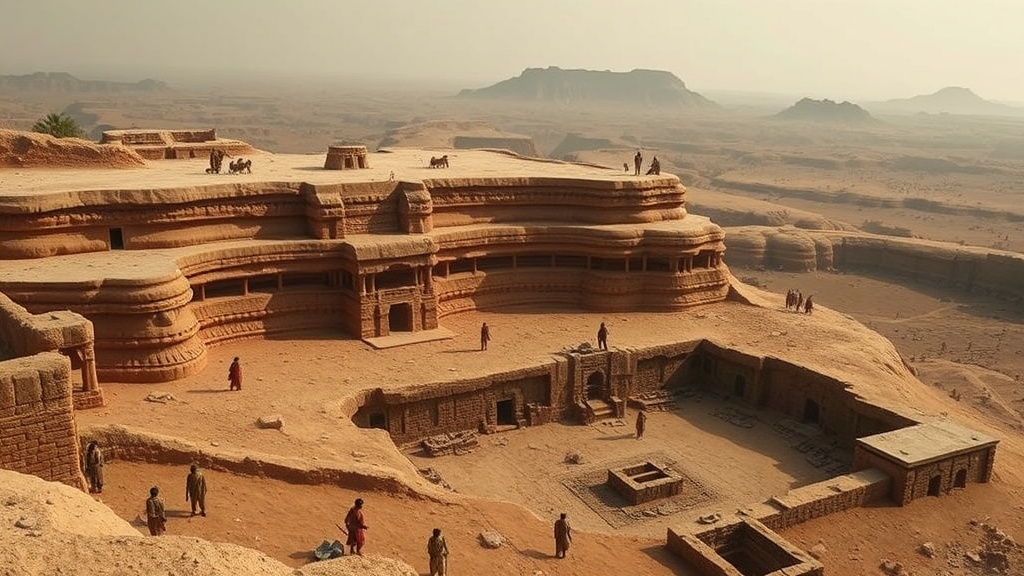
Sanskrit legal texts, or dharmasastras (treatises on law and conduct), present a highly structured, rigid vision of ancient Indian society. These texts detail the consequences of varnasamkara (the mixing of social classes), describing where the offspring of forbidden inter-caste unions were permitted to live, what duties they were assigned, and how they were to be excluded from the core rituals of the community. Yet, when an archaeologist stands in an excavation trench, trowel in hand, these neat textual categories quickly dissolve into the damp earth.
In the study of ancient India, there is a recurring tension between the idealized social order preserved in texts and the messy reality preserved in soil. While historical texts outline strict spatial and social boundaries for marginalized groups, the material record often tells a far more ambiguous story. A domestic hearth or a waste pit cannot easily reveal the social status, lineage, or forbidden ancestry of its ancient users.
The Limits of the Material Record
In Indian archaeology, researchers frequently rely on reports from the Archaeological Survey of India (ASI) and studies published in journals such as Antiquity, Man and Environment, and Puratattva to reconstruct daily life. These reports detail the stratigraphy—the analysis of sequential soil layers—of ancient settlements. A typical excavation might reveal a buried hearth, a cluster of potsherds (broken pieces of ceramic ware), animal bones, and charcoal.
While these artifacts can tell us what ancient people ate, how hot their fires burned, and what kind of clay they used to fashion their vessels, they rarely speak directly to social identity. Traditional Sanskrit texts suggest that those born of forbidden inter-caste relationships, particularly pratiloma (unions where the woman is of a higher caste than the man), were relegated to the margins of settlements. They were expected to use discarded vessels and live outside the main village boundary.
However, proving this spatial segregation in the archaeological record is exceptionally difficult. If an excavation uncovers a cluster of crude, poorly fired pottery outside a settlement wall, does this represent a community of social outcastes, or simply a temporary seasonal camp of pastoralists? Conversely, if a household within the main settlement used high-quality, slip-coated ceramics, does that guarantee the occupants held a high caste status?
As discussed in scholarly debates on how inter-caste relationships and their offspring were treated in ancient India, the lived reality of these social rules was far more fluid than the prescriptive legal texts imply. The material remains of a household reflect economic capability and functional utility rather than ritual purity. A wealthy family belonging to a theoretically "mixed" caste might still acquire fine goods, while a destitute family of a higher caste might cook on a simple, unadorned clay stove.
The Problem of Spatial Association
Another challenge lies in the nature of archaeological deposition. In an active settlement, waste pits and occupational layers accumulate over decades or centuries. Unless a site is abandoned suddenly due to a natural disaster, leaving household goods preserved exactly where they were used, the artifacts we find are usually secondary deposits. People move, rebuild, and reuse older materials.
A hearth excavated in a residential sector may have been used by multiple generations. Over fifty years, the social standing or lineage of the occupants of that house could have shifted, but the physical hearth remains structurally unchanged. Without written inscriptions directly associated with a specific domestic structure—such as name seals or inscribed potsherds—identifying the exact social or caste status of the inhabitants is nearly impossible.
Furthermore, many of the tasks relegated to lower-status or mixed-caste groups in texts, such as leatherworking or sanitation, leave highly ephemeral traces. Organic materials like leather, wood, and woven fibers decay rapidly in the acidic, monsoon-leached soils of the Indian subcontinent. While metalworking leaves behind slag, and butchery leaves behind cut-marked bones, these activities are not always confined to segregated spaces. In many ancient sites, workshops and residential areas were deeply integrated, complicating any attempts to map textual rules of segregation onto physical space.
Bridging the Gap Carefully
To address these limitations, modern Indian archaeology increasingly turns to science-based sub-disciplines. Forensic science, stable isotope analysis of human skeletal remains (which can reveal dietary differences and migration patterns), and archaeobotany are helping to reconstruct ancient lives with greater precision.
Even with these advanced tools, scholars must remain cautious. Tradition holds that caste boundaries were absolute and unchanging, but archaeological evidence shows that local economies, trade networks, and political shifts constantly reshaped social structures on the ground. When analyzing the material culture of ancient India, we must resist the temptation to force the complex, diverse stratigraphy of a physical site into the rigid, theoretical compartments of ancient legal manuals. The silent hearth in the trench reminds us that human lives were always more complicated than the laws written to govern them.