The Silt of Keezhadi: What Soil Micromorphology Reveals About Iron Age Flood Cycles
Soil micromorphology at the Keezhadi archaeological site reveals alternating layers of alluvial silt and human debris, challenging assumptions of uninterrupted urban occupation in the Vaigai Valley.

Rohan Bhattacharya for SwavedaAugust 16, 2026
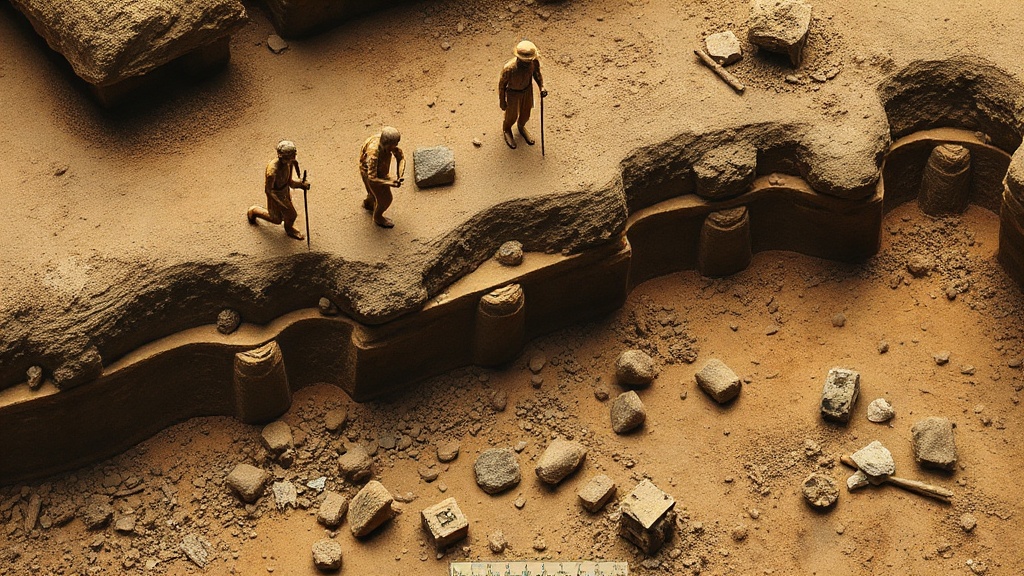
For decades, excavations in the Vaigai River valley of Tamil Nadu have fueled a grand narrative of early urbanism. The site of Keezhadi, located about 12 kilometers southeast of Madurai, has yielded brick structures, ring wells, and pottery inscribed with Tamil-Brahmi script. These discoveries have pushed back the timeline of urbanization in South India to the mid-first millennium BCE.
Yet, the macro-level view of these trenches—the impressive walls and large storage vessels—often obscures the finer stratigraphic record written in the dirt itself. Stratigraphy is the study of rock and soil layers to understand the chronological sequence of a site. When researchers look closer, the narrative of a continuous, uninterrupted urban golden age begins to show complex physical interruptions.
In archaeological reports published by the Archaeological Survey of India (ASI) and academic journals like Antiquity and Man and Environment, researchers are increasingly turning to soil micromorphology to reconstruct site histories. Soil micromorphology is the microscopic study of undisturbed soil and sediment samples to identify the precise processes that formed them. By looking at thin sections of soil under a polarizing microscope, we can see the microscopic history of human occupation and environmental change.
In trench YD1/2 at Keezhadi, this microscopic view reveals a cycle of human struggle against the natural dynamics of the Vaigai River. Instead of a single, unbroken block of occupation, the lowest levels of the site show clear evidence of alternating phases: periods of human habitation interrupted by significant river flooding. This micromorphological perspective, detailed in the excavation reports of the Tamil Nadu State Department of Archaeology (TNSDA), challenges the popular view of an immediate, massive urban center.
Reading the Micromorphology of Trench YD1/2
To the naked eye, the lower stratigraphy of Keezhadi looks like a sequence of dark, charcoal-flecked occupational soils. However, microscopic analysis of thin sections—soil samples hardened with resin and sliced thin enough for light to pass through—reveals a different story.
The sediment of trench YD1/2 shows a recurring pattern of two distinct microscopic structures. The first structure consists of poorly sorted, highly fragmented anthropogenic (human-made) debris. This includes microscopic fragments of burned daub (clay used in wall construction), crushed pottery, bone fragments, and phytoliths (microscopic silica structures formed in plant tissues). This layer represents active, daily human occupation.
The second structure, which repeatedly interrupts these occupational layers, is composed of well-sorted, laminated fine silts and clays. These mineral grains are rounded and oriented in a single direction. Under a polarizing microscope, this pattern is a classic signature of low-energy alluvial deposition. Alluvial deposition is the process where standing or slow-moving water leaves behind fine sediment as it recedes.
Evidence shows these fine silt layers contain no charcoal, no fragmented pottery, and no microscopic indicators of trampling or human movement. This lack of human debris indicates that during the times these silt layers were deposited, the immediate area of trench YD1/2 was not actively occupied by humans. Instead, it was underwater or recently dried out after a seasonal flood.
The Flood Cycles of the Vaigai Valley
The presence of these alternating layers suggests that the early inhabitants of Keezhadi did not settle an entirely dry, stable landscape. Instead, they lived in a highly dynamic river valley subject to periodic flooding.
Scholars debate the exact frequency of these flood cycles during the mid-to-late first millennium BCE. Some researchers argue that the floods were catastrophic events that forced the complete abandonment of the lower terrace for decades. Others suggest a more seasonal, manageable cycle, where residents temporarily retreated to higher ground nearby during the monsoon months and returned to rebuild once the waters receded.
The micromorphological evidence from the lower levels supports the latter model of seasonal or semi-regular adaptation. The clay-and-silt bands are relatively thin, and they are directly overlain by new layers of domestic refuse and rebuilt clay floors. There are no thick, weathered soil horizons (layers of soil formed by long-term exposure to weather without new sediment) on top of the flood silts. This absence of weathering indicates that the land did not sit empty for centuries between floods. Instead, humans returned quickly to reclaim the damp silt, using it as a level foundation for the next phase of construction.
This cycle of flooding and rebuilding explains why early Keezhadi lacks massive, permanent stone foundations in its earliest phases. Lightweight structures made of timber, bamboo, and thatch, plastered with local clay, were far easier to clear and rebuild after a seasonal inundation than heavy masonry.
Beyond the "Oldest Urbanism" Headline
The focus of popular archaeological reporting in India often centers on establishing the oldest possible dates for a site. However, field archaeologists recognize that understanding how an ancient society interacted with its environment is far more valuable than simply chasing older radiocarbon dates.
The microscopic layers of trench YD1/2 show that urbanization in the Vaigai Valley was not a sudden, permanent triumph over nature. It was a gradual, halting process of negotiation with a temperamental river. The early residents of Keezhadi did not build a city despite the floods; rather, their seasonal patterns of movement, agriculture, and construction were directly shaped by the water and silt of the Vaigai.
By focusing on these microscopic details, researchers can move past generalized historical narratives. The silt of Keezhadi proves that the true story of ancient South Indian urbanism lies not in uninterrupted glory, but in the resilient, repetitive acts of cleaning up after the water retreated.
Source List
- Tamil Nadu State Department of Archaeology (TNSDA) Excavation Reports: https://www.tamildigitallibrary.in/
- Archaeological Survey of India (ASI) Publications: https://asi.nic.in/