The Road to the South: Testing a Sangam Poem's Mauryan Campaign Against Deccan Stratigraphy
A Sangam-age poem says the Mauryas cut roads through southern mountains. Karnataka's Ashokan edicts and the Sannati excavations tell a slower, messier story.

Rohan Bhattacharya for SwavedaJuly 31, 2026
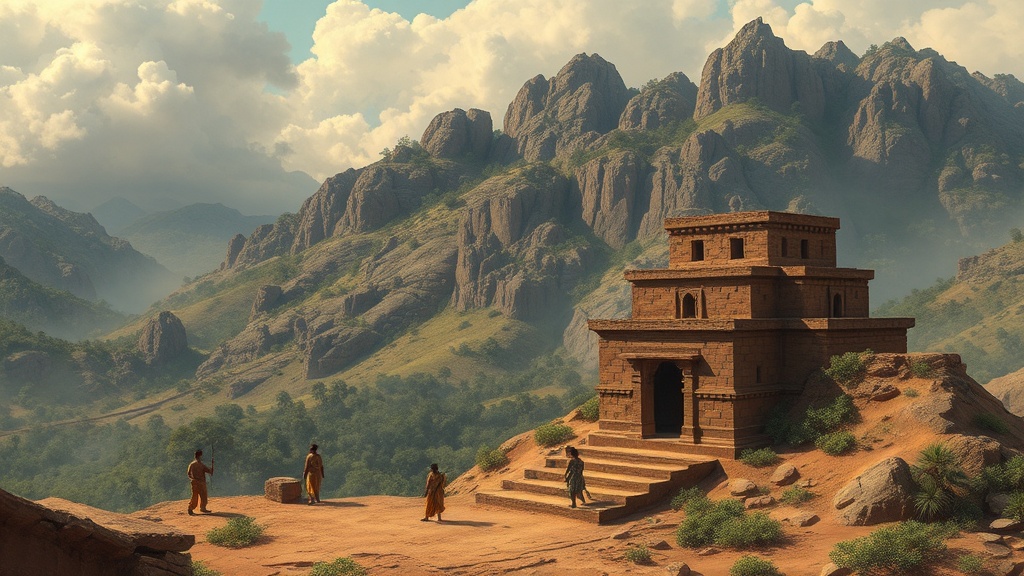
A line of Tamil verse claims an empire cut its way through mountains to reach the far south. The stratigraphy underneath those mountains has never quite agreed.
The poem in question comes from the Akananuru, an anthology of love and war poetry compiled in the early centuries CE and traditionally associated with the poet Mamulanar, who wrote several verses referencing the "Moriyar" — a Tamil rendering of Mauryas — advancing into peninsular India. A recent discussion thread on the subject lays out how these Sangam references to Magadha and the Mauryas have been read by later commentators as evidence of an actual military campaign reaching the Deccan and beyond (r/IndianHistory). The image is vivid: chariots and soldiers breaking a path through hill country that had never seen a paved road, forcing open a route the poets clearly regarded as unprecedented.
Sangam poetry is not a chronicle. It is praise poetry, composed for patrons, thick with metaphor and hyperbole. A poet describing a "road cut through mountains" is not necessarily describing engineering. He may be describing power — the kind of power a Tamil chieftain wanted associated with his own name by comparison. That distinction matters, and it is the reason this story has to leave the poem behind and go looking for dirt.
What the ground actually holds
The clearest physical trace of Mauryan authority in the peninsula isn't a road. It's stone with writing on it. Ashoka's Minor Rock Edicts turn up at a cluster of sites in northern Karnataka — Brahmagiri, Siddapura, Jatinga-Rameshwara, Maski, Gavimath, Palkigundu and Nittur among them — inscribed in Brahmi and Prakrit, announcing the emperor's turn toward dhamma (a term for moral and social conduct, roughly "righteous rule"). These are genuine, physically verified survivals of Mauryan administrative reach into the Deccan, not literary report. Maski in particular is notable because the edict there is one of the few Ashokan inscriptions to name Ashoka directly rather than using his title, which helped confirm the identification of "Devanampiya Piyadasi" with Ashoka in the first place (Wikipedia, Maski).
Further south and east, Sannati in Kalaburagi (Gulbarga) district, Karnataka, produced an Ashokan edict of its own, along with the adjoining Buddhist site of Kanaganahalli, where excavation turned up a stupa complex with early historic occupation layers. Sannati is the single strongest piece of evidence that Mauryan political reach extended well into the Deccan interior rather than stopping at its northern edge (Wikipedia, Sannati). But an inscription proclaiming imperial values is not the same thing as a destruction layer, a garrison, or a fortification wall dated to a military campaign. No published stratigraphic sequence from Sannati shows a burn layer, weapon cache, or sudden fortification episode that can be pinned to a Mauryan invasion force moving south. What the site shows instead is continuity — an early historic settlement that absorbed Mauryan-period material culture, coinage patterns, and eventually Buddhist monumental architecture, layered gradually rather than imposed in one violent event.
That gradualism is the pattern archaeologists keep running into across the northern Deccan more broadly: Northern Black Polished Ware, punch-marked coins, and Brahmi literacy spread into the peninsula in overlapping waves that look far more like trade networks and itinerant monks than an army's supply line. A road built by soldiers should leave traces of engineering — cut gradients, retaining walls, milestones. A road built by traders leaves potsherds, coin hoards, and inscriptions scattered along river valleys and hill passes wherever merchants found it convenient to stop. The Deccan record, so far, looks far more like the second.
Two registers, one mountain range
None of this means the Sangam poets invented the Mauryas out of nothing. Tradition holds that Mamulanar's generation had real memory, or at least real hearsay, of a northern power whose name carried weight as far south as the Tamil country — why else invoke it as a boast. Evidence shows that Mauryan political and religious authority did reach into Karnataka, confirmed by the edicts themselves. What evidence does not yet show is a synchronized military campaign that physically punched a road through the Western Ghats or the Deccan plateau in one dated episode.
Scholars debate how far to push the correlation between the "Moriyar" of Akananuru and the historical Maurya empire attested at Maski and Sannati — whether the poem preserves distorted memory of a real frontier war, or whether it borrows an imperial name the way court poetry often borrows prestige vocabulary, regardless of literal event. Stratigraphy at Sannati and the surrounding Kalaburagi sites hasn't produced the kind of destruction horizon that would settle it either way. The mountain in the poem may have been real. The road through it, on present evidence, was built more slowly than the verse admits.