The Problem with 'Neolithic' Swat: Why Elanai-kamar Challenges the Limits of Stone Age Labels
A preliminary survey of the Elanai-kamar rockshelter in the Swat valley challenges traditional Stone Age labels, revealing a complex transition from foraging to farming in the Hindu Kush foothills.

Rohan Bhattacharya for SwavedaAugust 3, 2026
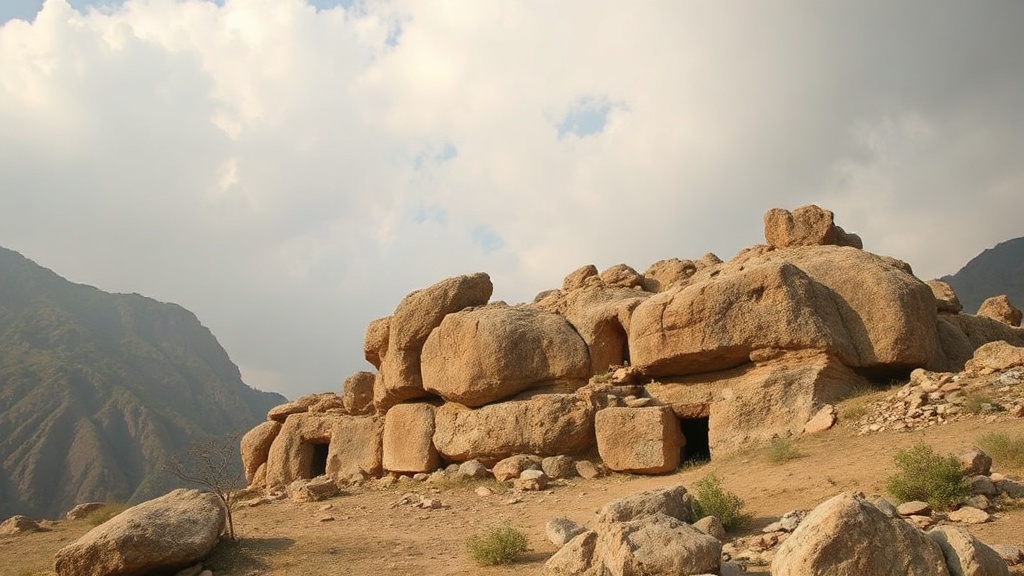
The transition from mobile foraging to settled agriculture in South Asia is rarely a sudden, clean break. In the mountainous terrain of northern Pakistan, this transition is particularly messy, yet archaeologists have long relied on rigid chronological blocks—such as the Mesolithic (Middle Stone Age) and the Neolithic (New Stone Age)—to categorize ancient sites.
A preliminary survey of the Elanai-kamar rockshelter in the Swat valley, published by Irene Caldana and colleagues in the journal Archaeological Research in Asia, highlights the limitations of these conventional labels. By examining the site's stratigraphy (the analysis of soil layers) and its material culture, the research team raises critical questions about how researchers define the Neolithic boundary in the Hindu Kush foothills.
The Stratigraphy of Elanai-kamar
Elanai-kamar is a rockshelter located in the Babuzai tahsil (an administrative subdivision) of the Swat District, situated at an elevation of roughly 1000 meters above sea level. Unlike open-air sites, where wind and water erosion frequently scramble archaeological contexts, rockshelters often preserve distinct occupational layers.
The survey team excavated a test trench to document the site's sequence. They identified a series of distinct stratigraphic units. The uppermost layers contained modern and historical debris, but beneath these lay undisturbed deposits containing pre-historic cultural materials.
A key focus of the study is Stratigraphic Unit 5, a layer characterized by a dark brown, compact clayey silt. This layer yielded a concentration of charcoal fragments, animal bones, pottery sherds, and stone tools. Radiocarbon dating of charcoal samples from this unit returned a chronological range of 2881–2631 BCE. This date places the occupation square within the late fourth to early third millennium BCE—a period traditionally associated with the transition to food production in the region.
Sifting the Material Culture
The stone tool assemblage at Elanai-kamar complicates simple classification. Archaeologists working in South Asia have historically associated the Neolithic with polished stone axes, grinding stones, and a decline in microliths (small, geometric stone tools typically used in composite weapons).
However, the lithic (stone tool) collection from Elanai-kamar's pre-historic layer consists primarily of flake-based tools, debitage (waste flakes from toolmaking), and micro-blades made from locally sourced quartz and fine-grained river cobbles. Traditional typologies might classify such an assemblage as Mesolithic due to the persistence of these small stone technologies. Yet, these tools coexisted with pottery and domestic activity.
The pottery recovered from the site is equally ambiguous. The sherds are predominantly handmade, coarse, and tempered with grit or organic materials. Some vessels display burnishing (polishing by rubbing with a smooth stone) and basketry impressions on their bases—features that resemble the early ceramic traditions of Ghalegay, another key Swat valley site excavated by the Italian Archaeological Mission in Pakistan during the mid-twentieth century.
This material blend suggests that the inhabitants of Elanai-kamar were practicing a mixed subsistence strategy. They retained the mobile toolkit of hunters and gatherers while incorporating pottery and potentially managing domesticated animals or plants.
Challenging the Neolithic Boundary
The co-occurrence of "Mesolithic-style" stone tools and "Neolithic-style" ceramics at Elanai-kamar challenges the utility of using these Eurocentric developmental stages in the Hindu Kush.
In European archaeology, the Neolithic package—pottery, ground stone tools, permanent architecture, and domesticated plants and animals—often appears as a relatively synchronized toolkit. In South Asia, however, reports published in journals like Man and Environment and Puratattva have long documented that these technologies appeared at different times in different regions.
Evidence shows that communities in northern Pakistan adopted pottery and small-scale cultivation without immediately abandoning their mobile lifestyles or their traditional stone tool technologies. By forcing Elanai-kamar into a strict "Neolithic" box, researchers risk obscuring the localized, gradual adaptations that characterized life in the mountain valleys.
Implications for Swat Valley Archaeology
The Swat valley has long been a critical corridor for the movement of people, technologies, and ideas between Central Asia, the Iranian Plateau, and the Indo-Gangetic plains. Previous reports by the Archaeological Survey of India (ASI) and international teams have mapped numerous historical and Buddhist-era sites in the region, but the deep pre-historic sequence remains comparatively understudied.
The preliminary findings at Elanai-kamar underscore the need for a more flexible chronological framework. Rather than searching for a sharp boundary where the Stone Age ends and the farming era begins, the evidence suggests that scholars should focus on the continuity of local resource use.
The site's stratigraphy preserves a record of environmental adaptation. The transition from mobile foraging to settled agriculture was not a sudden revolution, but a slow process of trial, error, and cultural mixing. As researchers conduct further excavations and recover botanical and faunal remains, the details of this transition will become clearer, likely rendering old chronological labels even more obsolete.