The Practical Past: What Mohenjo-daro's Drains and Wells Tell Us That Its Missing Palaces Don't
No palace, no royal tomb, no deciphered script — just drains, wells and stone benches. Mohenjo-daro's daily-life evidence is stubborn, mundane, and more honest than the grand theories built on top of it.

Vikram Joshi for SwavedaJuly 27, 2026
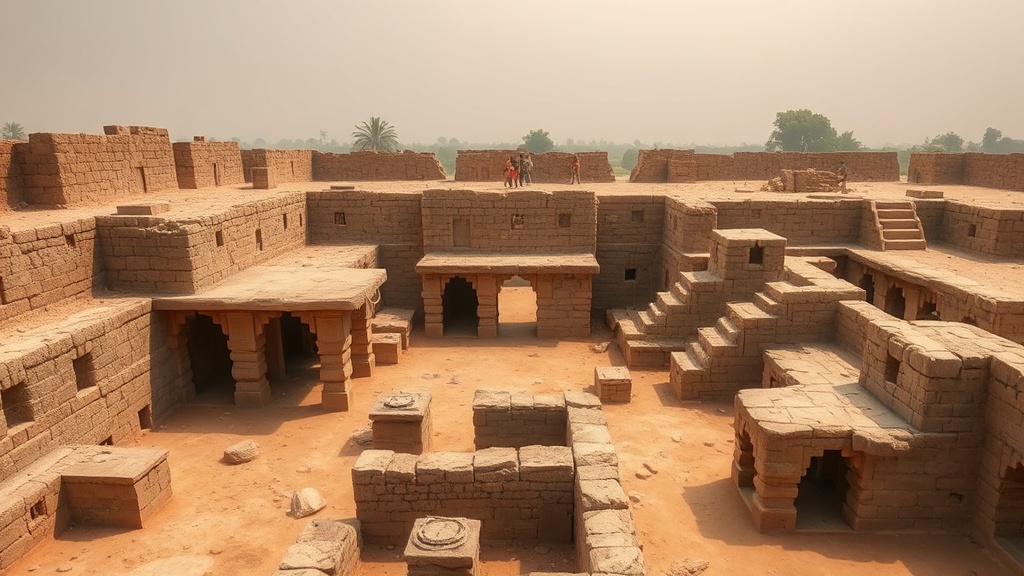
Walk the lanes of Mohenjo-daro today and you will not find a throne room. You will find a drain.
That is not a disappointment. It is the point. The site in Sindh, Pakistan — one of the two largest cities of the Indus Valley Civilization, also called the Harappan civilization after the type-site of Harappa — has produced no palace, no royal tomb, no monumental inscription naming a king or a god. What it has produced, in abundance, is plumbing: covered brick drains running along streets, private wells sunk into courtyards, soak pits for household waste, and platforms and benches whose function archaeologists still argue over. A visitor's guide to the ruins put together by the research and archive project Harappa.com walks through this physical layer of the city street by street — and it is a useful corrective to the tendency, common in textbook summaries, to skip straight to abstraction: "advanced civilization," "urban planning genius," "possible trade empire." The ground itself asks smaller, harder questions first.
The drains as an argument
The most cited feature of Mohenjo-daro's Lower Town is its drainage network — brick-lined channels running beside the main streets, connected to soak pits and covered where they passed under doorways, as described in the Harappa.com explorer's guide. Individual houses had their own bathing areas and latrines that fed into this system rather than into the open street.
That is a mundane fact. It is also an argument, whether or not the people who built it meant it as one. A city that invests in shared sanitary infrastructure at this scale — rather than leaving waste disposal to individual households acting alone — is making a decision about collective life. It implies some authority, or at least some agreed convention, capable of enforcing a street grid and a plumbing standard across many separate homes. Textbook histories tend to leap from this observation straight to "centralized state" or "priest-kings," borrowing the vocabulary of Mesopotamia and Egypt because that vocabulary already exists. The drains support a narrower claim: coordination happened. Who coordinated it, and by what mechanism, is not something the bricks can tell us, and the absence of any deciphered administrative text — the Indus script remains undeciphered — means we cannot check the bricks against a written record the way we can in Sumer.
Wells, not fountains
The guide also details the city's wells — some serving single households, others apparently shared by several homes or a cluster of buildings, built up in brick rings as the street level rose over generations of habitation (Harappa.com). This detail matters more than it looks. A shared well is a small, repeated social event: neighbors drawing water at the same spot, at overlapping hours, for centuries. It is not evidence of religion, kingship, or trade — the categories textbooks reach for — but it is very good evidence of neighborhood, in the literal sense of people who lived near each other and depended on the same fixed point in the ground. Reconstructing "daily life" honestly means sitting with that scale of evidence rather than skipping past it toward something more dramatic.
Benches, platforms, and the limits of reading stone
Mohenjo-daro's citadel mound — the raised, walled portion of the city — contains structures whose plain physical remains have attracted the largest and most speculative interpretations: the Great Bath, a brick-lined tank with steps at each end, and the so-called Great Granary, a large pillared building near it, both described in the Harappa.com guide. The Bath's watertight construction and its steps are physical facts. That it was used for ritual bathing is a widely repeated interpretation, not a demonstrated one — there is no inscription confirming purpose, and the "granary" identification has been challenged by later scholars precisely because no grain residue was conclusively recovered inside it. This is the gap this piece keeps returning to: the physical remains are solid; the functional labels stacked on top of them are inference, sometimes reasonable inference, sometimes closer to habit inherited from early twentieth-century excavation reports.
Why the ground resists grand theory
Textbook chapters on the Indus Valley Civilization often move quickly to sweeping claims — a peaceful trading empire, a uniform religious system, a script waiting to reveal royal genealogies. The material record at Mohenjo-daro pushes back against that speed. Streets, drains, wells, and brick platforms are legible. Kingship, theology, and politics are not, because the one kind of evidence that could confirm them — a readable text — does not exist yet. What the ruins do confirm is narrower and, in its way, more interesting: that Harappan city-dwellers built and maintained shared plumbing, drew water from common wells, and organized their neighborhoods around fixed domestic infrastructure long before anyone can say with confidence who was in charge of any of it.
That is not a smaller story than the one textbooks usually tell. It is a more honest one — tradition, evidence, and open debate kept carefully apart, the way the drains themselves were kept apart from the street.