The Potsherds of Quseir al-Qadim: What Tamil-Brahmi Graffiti on Red Sea Amphorae Reveals About Early Indo-Roman Merchant Guilds
Tamil-Brahmi inscriptions on 1st-century CE pottery fragments at the Egyptian port of Quseir al-Qadim offer physical evidence of early South Indian merchants operating within the Roman Red Sea trade networks.

Rohan Bhattacharya for SwavedaAugust 26, 2026
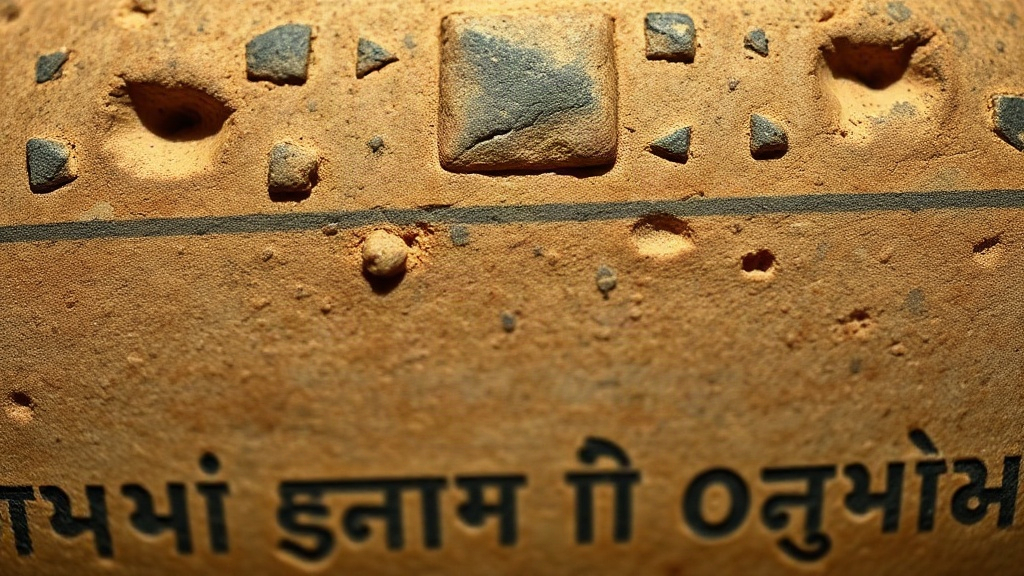
The dry, salt-crusted layers of the Egyptian Red Sea coast have preserved details of ancient maritime trade that the humid soil of southern India has long since dissolved. At the site of Quseir al-Qadim, identified as the Roman-era port of Myos Hormos, excavations have yielded shattered fragments of coarse red ware pottery that bear scratch marks made before the vessels were broken. These graffiti are not decorative. They are short inscriptions written in Tamil-Brahmi (a regional script variant used in southern India during the early historical period).
In the study of ancient trade, there is a constant tension between high-level economic theories and the physical reality of the trenches. While literary texts like the Periplus Maris Erythraei (an anonymous 1st-century CE Greek travelogue detailing navigation in the Erythraean Sea) outline the broad logistics of Indo-Roman commerce, the potsherds of Quseir al-Qadim offer direct, physical evidence of the specific individuals who traveled these routes.
The Stratigraphy of Myos Hormos
During excavations conducted by the University of Chicago in the late 1970s and early 1980s, directed by Donald S. Whitcomb and Janet H. Johnson, a series of trash dumps and storage areas yielded thousands of pottery fragments. Among these were sherds of coarse earthenware that did not match local Egyptian fabrics or Mediterranean amphorae (large two-handled clay jars used to transport wine, oil, or fish sauce).
According to reports published in the journal Antiquity and analyses by epigraphists, these potsherds featured post-firing graffiti incised into the clay. The script was identified as Tamil-Brahmi, dating typologically to the 1st century CE. This assessment aligns with the Roman-era stratigraphy of the site, which is securely anchored by associated Roman coins, Greek papyri, and characterized terra sigillata (fine, red-gloss Roman pottery).
Rather than the grand pronouncements of kings or elite donors found on rock-cut caves in the Western Ghats of India, the Quseir al-Qadim inscriptions are brief, personal names. The most famous of these fragments bears the cleanly incised name Kanan, while another reads Catan.
Deciphering the Names: Kanan and Catan
In Indian epigraphy, naming conventions provide crucial clues about social structure and trade organization. The name Kanan is a common Tamil personal name, while Catan (often transliterated as Sathan) is closely linked to merchants in Sangam literature (the classical Tamil corpus spanning the early centuries BCE to the early centuries CE).
In Sangam texts, a ma-cattu-van (great caravan merchant) refers to a wealthy trader. The presence of these names scratched onto utilitarian pottery vessels in a Roman port on the Red Sea suggests that South Indian merchants were not merely passive suppliers waiting for Western Roman fleets to arrive at southern Indian ports like Muziris (an ancient, wealthy port city on the Malabar coast of southwestern India) or Arikamedu (an ancient coastal trading post in southeastern India near modern Puducherry). Instead, evidence shows that Tamil-speaking traders traveled aboard the ships, established temporary or permanent residences in Roman ports, and brought their own domestic vessels or marked their personal property upon arrival.
Skeptics of long-distance Indian merchant travel often point to the lack of structural remains, such as permanent temples or dedicated brick warehouses, in Egypt to argue that Indian presence was minimal or fleeting. However, as noted in reports by the Archaeological Survey of India (ASI) and discussions in the journal Puratattva, the nature of ancient maritime diaspora communities is rarely characterized by monumental architecture. Instead, it is found in the domestic debris—the broken cooking pots, the personal names scratched on water jars, and the specific food residues left in hearths.
The Ceramic Evidence
The fabric of the potsherds themselves is highly telling. Mineralogical analysis of the Kanan sherd indicates that the vessel was manufactured from clay common to the western coast of India or the Kaveri River basin, rather than the Nile Valley. This indicates that the pottery was carried as personal cargo from South India, likely containing provisions for the long voyage across the Indian Ocean, which took advantage of the seasonal monsoon winds.
The use of Tamil-Brahmi on these vessels also highlights the linguistic landscape of early Indian ocean trade. While Prakrit (an ancient Indo-Aryan vernacular language) and Ashokan Brahmi were widely used for administrative and religious purposes in northern and central India during this period, Tamil-Brahmi was the tool of choice for the mercantile classes of the Chera, Chola, and Pandya kingdoms of the far south. The appearance of this script at Quseir al-Qadim, and similarly at the sister port of Berenike further south, confirms that southern Indian merchant guilds operated with a high degree of literacy and organizational independence.
Rather than relying on speculative reconstructions of vast Indian merchant empires, the physical epigraphy of Quseir al-Qadim forces a focus on the mundane realities of the trade. A merchant named Kanan sat in a dusty Roman port on the edge of the Eastern Desert, identified his water jar by scratching his name into the red clay, and left behind a microscopic layer of evidence that survives today.