The Oracles of Assam: Divination and Governance in the Ahom Kingdom
The Ahom kingdom managed its state affairs through ritualized divination, blending Tai-Ahom spiritual traditions with the practical necessities of military and political administration.

Devika Menon for SwavedaJuly 15, 2026
The Ahom kingdom, which ruled the Brahmaputra Valley from 1228 to 1826, did not separate the functions of government from the observation of omens. While a numismatist might look at the octagonal gold and silver coins of the later Ahom kings—such as those minted by Rudra Singha, bearing the Sanskrit legend Sri Sri Hara Gauri Padaparayanasya (Devoted to the feet of Shiva and Parvati)—as evidence of a shift toward localized Brahminical Hinduism, the earlier statecraft relied heavily on the Buranjis (chronicles) and the ritual guidance of the Deodhais (Ahom priests).
The Deodhais acted as the keepers of the Phung-Chin (traditional religious manuscripts written on sanchi bark). Unlike the maritime trade records of the Cholan period or the inscriptions found in the Periplus of the Erythraean Sea, which emphasize commodity exchange and port geography, the Ahom state records focus on the intersection of celestial movement and political stability.
The Role of the Deodhai
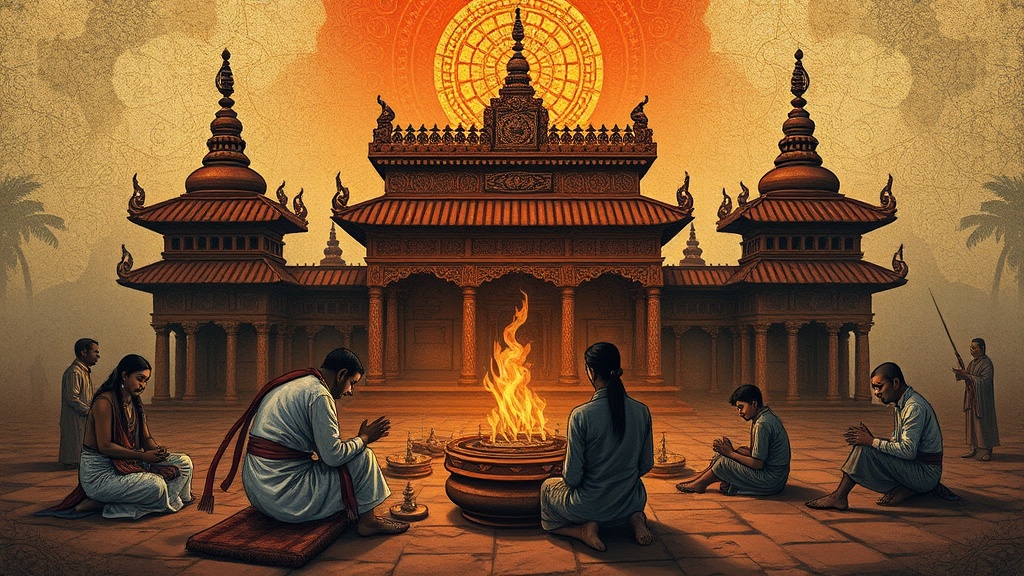
The Ahom administration maintained a formal class of diviners who consulted the Phung-Chin before any major state decision, including the declaration of war or the construction of new fortified embankments. According to Yasmin Saikia's analysis of Ahom identity, these rituals were not merely religious; they were central to the legitimacy of the monarch. The king, known as the Swargadeo (Lord of Heaven), derived his authority from the belief that he ruled according to the cosmic order.
When a ruler prepared for a military campaign against the Mughals, the Deodhais performed specific rites. Tradition holds that these divinations involved the examination of chicken bones—a practice common among many Tai-speaking groups—to determine the favorability of an engagement. Scholars debate the extent to which these rituals dictated military strategy, but evidence shows that the Ahom military high command, known as the Barphukan and Barbarua, consistently paused for these ritual consultations.
Cosmology and Infrastructure
The Ahom state was built on labor-intensive infrastructure, specifically the pams (farmlands) and the vast network of embankments. The placement of these structures was rarely random. Historical records indicate that the timing for starting construction on major tanks, such as the Joysagar tank commissioned by Rudra Singha, was determined by auspicious celestial alignments.
This is not unlike the careful orientation of Roman colonial foundations or the precise alignment of temple architecture in South India. In the Ahom context, the king functioned as the primary mediator between the terrestrial kingdom and the divine. The Deodhais provided the technical interpretation of these signs, effectively acting as high-level political advisors.
The Transition of Statecraft
As the Ahom state expanded throughout the 17th and 18th centuries, the influence of these indigenous divinatory practices faced pressure from Sanskritization. The adoption of Hindu rites did not immediately replace the older Tai-Ahom traditions. Instead, the two systems began to operate in parallel.
The Government of Assam’s history documentation notes that the royal household maintained the worship of Chumdeo (the ancestral deity of the Ahom kings) throughout the duration of the dynasty. This deity remained the focal point of the kingdom's ritual life, even as kings took on Hindu names and adopted the Persian-influenced administrative language of their neighbors.
Hard Evidence in the Archives
For the historian, the Buranjis serve as the primary source for understanding how these rituals functioned in practice. These chronicles, often written in the Ahom language initially and later in Assamese, detail the specific omens that occurred before historical turning points, such as the Battle of Saraighat.
While modern observers might view these omens as secondary to the tactical superiority of Ahom naval warfare—a discipline they excelled at, much like the seafaring empires of the South—the Ahom leadership viewed the spiritual and the tactical as inseparable components of the state apparatus. Evidence shows that the Swargadeo would delay military mobilization if the Deodhais read the portents as negative, demonstrating that the ritual system was a non-negotiable layer of the decision-making process.
The Ahom model of governance highlights a specific approach to power: one where state survival was predicated on constant dialogue with the supernatural. Through their preserved manuscripts and the persistence of their temple architecture, the Ahom kingdom provides a clear view into a political system that prioritized cosmological alignment as a pillar of territorial administration.