The Glass of Pattanam: What Chemical Fingerprinting of Monochrome Beads Reveals About Early Indo-Roman Maritime Trade Logistics
Chemical and typological analyses of Indo-Pacific monochrome glass beads from Pattanam, Kerala, provide physical evidence of local South Indian manufacturing using imported raw material from the Roman world.

Rohan Bhattacharya for SwavedaAugust 20, 2026
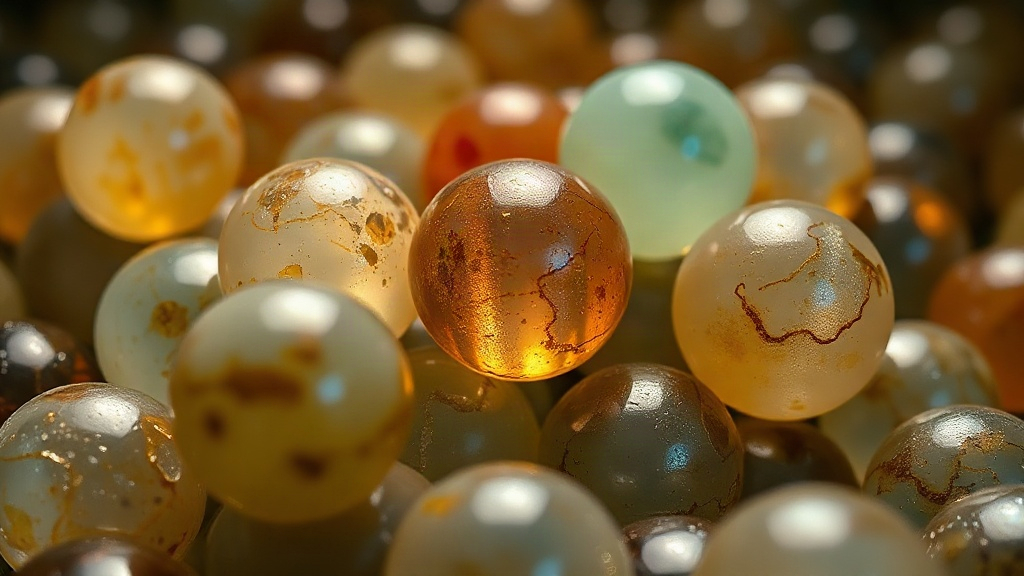
In the study of ancient Indian Ocean trade, researchers have frequently relied on literary accounts like the Periplus Maris Erythraei (Voyage around the Erythraean Sea) or the Sangam Tamil poems to map the movement of goods along the Malabar Coast. However, relying on texts alone often obscures the ground-level logistics of production and exchange. At the site of Pattanam in Kerala, widely identified by researchers as the ancient port of Muziris, the physical evidence of this maritime network is preserved not in text, but in millions of tiny, colored artifacts: Indo-Pacific monochrome glass beads.
The stratigraphy of Pattanam reveals a long sequence of occupation, with major trade activity concentrated in the Roman-era layers dating from the first century BCE to the fourth century CE. In these trenches, excavators have recovered vast quantities of glass debitage (waste material from stone tool or glass manufacturing) alongside finished beads. To understand where these beads came from, researchers have turned to chemical fingerprinting, a method that analyzes the trace elements in glass to identify its raw material source. The results challenge the simple binary of "domestic" versus "imported" goods, revealing a complex supply chain where raw materials from the Mediterranean were transformed by South Indian artisans.
The Chemistry of Ancient Glass
Ancient glass is not uniform. Its chemical composition depends entirely on the sand and flux used in the melting process. In the Mediterranean and Western Asia, ancient glassmakers typically used mineral natron (a naturally occurring mixture of sodium carbonate decahydrate and related salts) as a flux to lower the melting point of silica. This produced low-magnesium, low-potassium soda-lime glass, which is chemically distinct from the glass produced in South Asia or East Asia.
In South Asia, early glassmakers historically used plant ash or mineral-rich river sands, resulting in high-alumina or high-potassium glass compositions. In reports published in the journal Antiquity and the Journal of Archaeological Science, chemical analyses of the Pattanam bead assemblage show a striking division. While some finished beads match known South Asian chemical profiles, a significant portion of the monochrome beads—specifically the deep blue and turquoise varieties—contain low-magnesium, high-alumina soda-lime glass that matches the composition of Roman raw glass blocks found in Mediterranean shipwrecks.
This chemical signature suggests that Pattanam was not merely a consumer of finished Western luxury goods. Instead, the port functioned as an active industrial hub. Roman merchants did not just bring finished vessels; they transported raw glass ingots as ballast or bulk cargo. Once these ingots landed on the Malabar Coast, local beadmakers re-melted the imported glass in local hearths, drawing it into the thin tubes required to manufacture thousands of identical, small monochrome beads.
Local Workshops and the Lada Method
In the journal Puratattva, reports on early Indian glass manufacturing highlight the use of the "lada" or drawn-glass method. Unlike the wound-glass technique common in Roman workshops, where molten glass was wrapped around a wire, South Indian artisans pulled molten glass into long, hollow tubes. Once cooled, these tubes were chopped into tiny segments and tumbled in hot ash and sand to round off the sharp edges.
The presence of thousands of unfinished bead fragments, glass slag, and distorted waste pieces at Pattanam confirms that this drawn-glass technique was practiced locally on a massive scale. By combining Roman raw material with indigenous South Indian manufacturing techniques, the workshops of Pattanam created a hybrid product. These highly durable, standardized beads were then exported from the Malabar Coast to markets across Southeast Asia and East Asia, where they have been recovered in early historic archaeological sites.
This specific logistical flow—importing raw material from the West, processing it using local technology, and exporting the finished product to the East—demonstrates that Pattanam was a crucial intermediary node in the global trade network of the first millennium CE.
Beyond the "Oldest Port" Claims
While regional tourism campaigns and sensationalist headlines often label Pattanam as the "cradle of globalization" or the "oldest port in India," field archaeologists adopt a more cautious perspective. In reports by the Archaeological Survey of India (ASI) and academic reviews in Man and Environment, researchers emphasize that Pattanam must be understood within its wider regional context.
The site did not exist in isolation. Its bead-making industry was closely linked to internal trade routes running across the Palghat Gap to the eastern coast of India, connecting with sites like Arikamedu. Arikamedu had its own massive bead-making industry, and comparative chemical analyses show that both ports shared similar technical knowledge and raw material sources.
Rather than looking for a single "lost civilization," the stratigraphy and chemical data of Pattanam offer a clearer look at ancient maritime logistics. The millions of tiny monochrome glass beads recovered from the Kerala soil prove that ancient trade was not just about the exchange of finished luxury items like Roman gold coins and wine amphorae (two-handled jars used for liquid storage). It was also driven by the bulk movement of raw industrial materials, shaped by the skilled hands of South Asian artisans working in coastal workshops.