The Glass Beads of Arikamedu: How Roman Pliny’s 'Luxury' Was Just Everyday Tamil Export Stratigraphy
Excavations at Arikamedu reveal that the ancient Indo-Roman trade was driven by mass-produced glass bead workshops, challenging Pliny the Elder's complaints of a drain on Roman gold for high-status luxury goods.

Rohan Bhattacharya for SwavedaSeptember 4, 2026
In his Naturalis Historia (Natural History), the Roman administrator Pliny the Elder famously lamented the financial drain of the Roman Empire, calculating that India, China, and the Arabian Peninsula absorbed at least one hundred million sesterces annually. Roman writers framed this eastern trade as an indulgence in high-status luxuries, describing exotic spices, silks, and fine gems destined for elite consumption.
However, the physical stratigraphy—the study of rock and soil layers to understand archaeological chronology—of the southern Indian coast tells a different story. At Arikamedu, an archaeological site located near Puducherry, the earth does not reveal a sparse scattering of rare, high-status objects. Instead, it contains deep, dense layers of industrial waste. Excavations show that the Indo-Roman maritime trade was anchored by highly standardized, high-volume manufacturing hubs producing everyday consumer items, particularly small glass beads.
The Stratigraphy of Waste
The first systematic excavations at Arikamedu, conducted by Sir Mortimer Wheeler in the 1940s and later expanded by Jean-Marie Casal, established a clear chronological sequence. Writing in the journal Antiquity and later reports for the Archaeological Survey of India (ASI), researchers identified distinct structural phases. The earliest layers contain local Megalithic (associated with large stone monument cultures of the Iron Age) Black-and-Red Ware pottery, which gradually interface with imported Roman ceramics. These imports include dual-handled amphorae (ceramic storage jars) used for wine or olive oil, and red-glazed Arretine ware (fine Roman tableware).
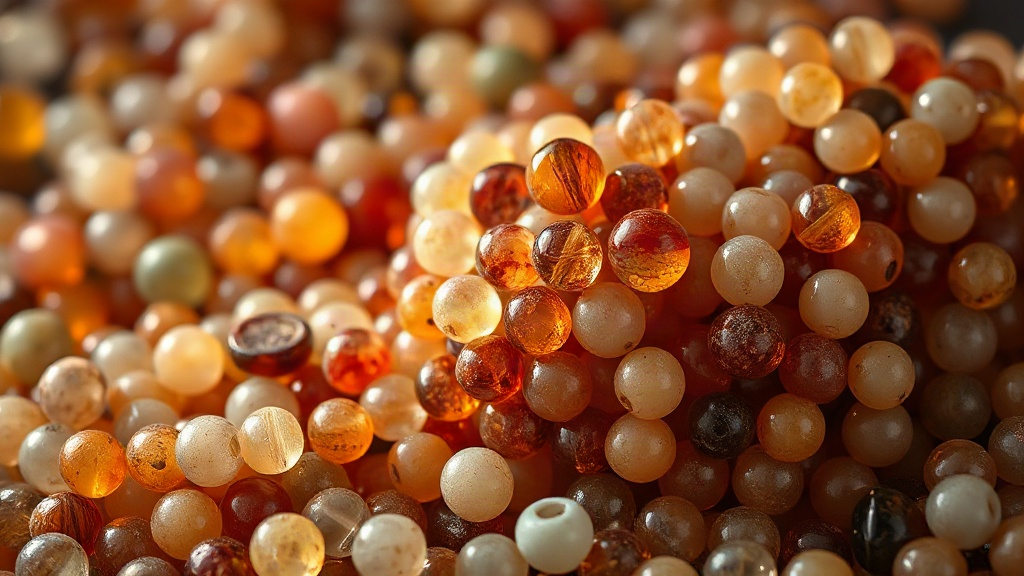
Below the diagnostic pottery imports lies a massive accumulation of glass-working debris. The stratigraphy does not show the slow, customized output of individual artisans. Instead, it reveals thick deposits of ash, slag (glass-making byproduct), melting pots, distorted kiln rejects, and millions of tiny monochrome glass beads.
These beads, often referred to in literature published in Puratattva as Indo-Pacific beads, are incredibly small, typically measuring under six millimeters in diameter. The sheer volume of waste indicates that the workshops of Arikamedu were optimized for mass production rather than the creation of unique, high-value luxury items.
The Lada Method of Mass Production
Evidence shows that Arikamedu beadmakers relied on a specialized manufacturing process known as the lada (tube-drawing) method. Archaeological analyses of the debris, discussed in Peter Francis Jr.'s seminal work, Asia's Maritime Bead Trade: 300 B.C. to the Present, reveal how these workshops achieved such high outputs.
Artisans gathered a batch of molten glass on a hollow iron pipe, creating a hollow bulb. By pulling the glass rapidly from both ends before it cooled, they drew out long, thin tubes of glass with a continuous central perforation. Once cooled, these tubes were chopped into thousands of tiny segments.
To round the sharp edges of the cut segments, workers mixed the raw beads with a slurry of ash and clay. This mixture prevented the glass from fusing together when reheated in a furnace. The rounded beads were then washed, sorted, and strung.
This process was designed for scale. The standardized colors—primarily opaque red, green, blue, and yellow—reflect a systematic approach to chemical coloring agents, using local iron and copper oxides to maintain consistency across production runs.
Reassessing the Roman "Luxury" Narrative
The presence of these massive bead-making deposits challenges the traditional literary narrative of the Indo-Roman trade. To Roman elites like Pliny, the eastern trade was a moral and economic crisis, characterized by the exchange of Roman gold coins for useless foreign vanities.
However, the archaeological record indicates a more complex, low-margin economic network. The beads produced at Arikamedu were not destined for the wealthy patricians of Rome, but rather for broad regional markets spanning Southeast Asia, East Africa, and the wider Indian Ocean littoral. Roman merchants operated as intermediaries in a globalized logistics network, exchanging Mediterranean agricultural surpluses, raw metals, and coinage for massive cargoes of everyday manufactured goods.
Scholars debate the exact degree to which Roman shipping controlled the distribution of these beads, but the geographical distribution of Indo-Pacific beads confirms their reach. They appear in early historic contexts from South Korea to West Africa, establishing Arikamedu as a primary manufacturing engine of the ancient world.
The deep stratigraphic layers of Arikamedu show that the "wealth of the East" was built on industrial efficiency. The true driver of this global trade network was not the rare gem or the exotic animal, but the systematic, high-volume production of tiny glass beads manufactured in the coastal workshops of ancient Tamil Nadu.