The First Anglo-Sikh War in Verse: Reading Shah Muhammad’s Jangnama
Shah Muhammad’s Jangnama offers a visceral, contemporary perspective on the First Anglo-Sikh War, balancing the cold administrative records of the British East India Company with the emotional stakes of the era.

Vikram Joshi for SwavedaJuly 15, 2026
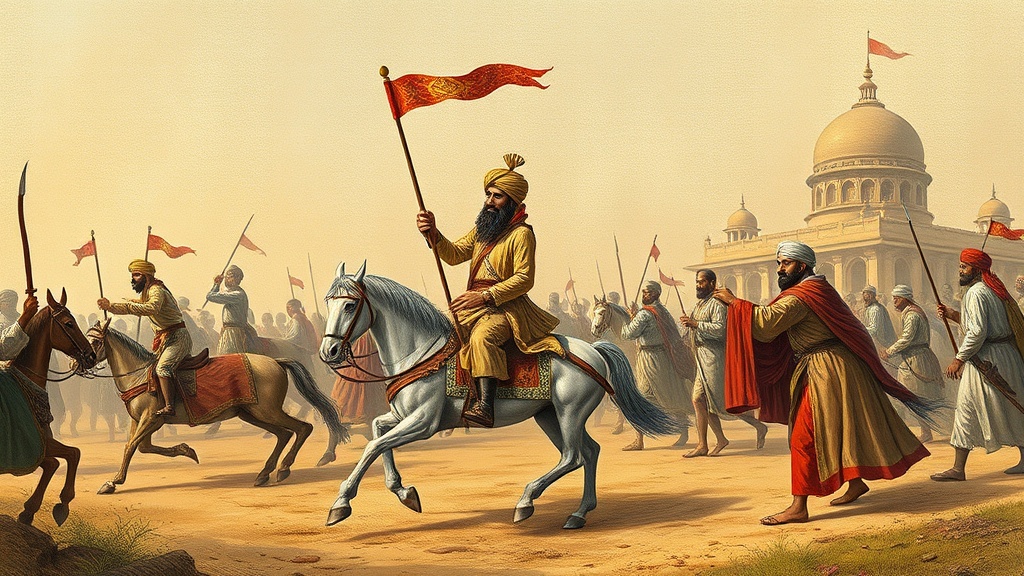
The First Anglo-Sikh War (1845–1846) remains one of the most consequential conflicts in the transition of South Asian power. While military historians rely on the administrative correspondence of the British East India Company and the formal treaties that concluded the fighting, another source offers a different vantage point: the Jangnama (war chronicle) of Shah Muhammad.
Shah Muhammad, a poet living during the mid-19th century in the Punjab region, composed his work shortly after the hostilities ended. Unlike the dry, tactical dispatches generated by colonial officials, his Jangnama—written in the Punjabi language—functions as a contemporary narrative account of the collapse of the Sikh Empire.
Poetry as a Historical Record
The Jangnama is a literary genre in Punjabi and Persian traditions that chronicles battles, often emphasizing the bravery of warriors and the tragedy of loss. In the case of the First Anglo-Sikh War, Shah Muhammad’s text provides insights into how the conflict was perceived by local observers. According to scholar Nikky-Guninder Kaur Singh, writing in Sikhism: An Introduction, traditional Punjabi literature frequently integrated the historical with the legendary, yet this specific work captures the immediate political anxiety following the death of Maharaja Ranjit Singh.
While administrative records from the British Library’s India Office Records focus on supply lines, troop movements, and diplomatic negotiations, the Jangnama prioritizes the emotional experience of the Sikh soldiers. It documents the breakdown of internal order and the sense of betrayal felt by those fighting the British forces. Scholars distinguish these accounts from "fact" in the modern empirical sense; they are better understood as cultural memory that preserves the perspective of the defeated party.
The Gap Between Archives and Narrative
Archival records, such as the Minutes of the Governor-General of India, provide the chronological backbone of the war. They confirm that the conflict began in December 1845 when Sikh forces crossed the Sutlej River, an act the British interpreted as an invasion.
Shah Muhammad’s account acknowledges this, but it frames the war through a lens of inevitability and sorrow. He focuses on the lack of unity among the Sikh leadership, a theme that resonates with later historical analysis. Historians such as J.S. Grewal, in The Sikhs of the Punjab, note that the post-Ranjit Singh period was characterized by deep instability. Shah Muhammad depicts this instability as a moral and political failing. His verses do not attempt to be an objective report; instead, they serve as a testament to the collective trauma of the community.
Distinguishing Tradition from Evidence
A critical reading of the Jangnama requires separating the poet's interpretations from the verifiable movements of armies. The text suggests that the war was a clash of destinies, a common trope in epic poetry. Archaeology and primary-source translation provide a different register. The physical remains of the fortifications used during the Battle of Mudki, for instance, align with the technical descriptions found in British military diaries rather than the heroic imagery of the poem.
However, dismissing the Jangnama as purely decorative would be a mistake. It preserves the specific vocabulary and vernacular understanding of the war. It catalogs the names of commanders, the locations of key skirmishes, and the prevailing mood of the populace—elements often missing from the sterilized documents of colonial bureaucrats.
When researchers consult the Jangnama, they are not looking for accurate artillery counts or precise casualty lists. They are looking for the "social history" of the conflict. Tradition holds that the poet witnessed or heard firsthand accounts of the desertions and the chaotic command structure that hampered the Sikh forces. While evidence confirms the collapse of centralized authority, the poem breathes life into those dry historical conclusions.
Integrating Multiple Perspectives
To understand the First Anglo-Sikh War, one must look at both the colonial archive and the regional literary tradition. The British records describe the "how" of the transition of power—the logistics of conquest and the legalities of annexation. Shah Muhammad’s verse addresses the "why" from the perspective of the people who lived through the rupture.
For current researchers, these literary sources act as a necessary counterweight. The British documents, while geographically precise, are inherently biased toward the narrative of imperial necessity. The Jangnama provides the necessary dissent. By comparing these disparate sources—the administrative minute, the military map, and the poetic chronicle—a more complete, though undeniably complicated, picture of the 1840s in Punjab emerges.
This approach grounded in linguistics and historical context allows us to appreciate the Jangnama not as a replacement for historical evidence, but as an indispensable companion to it. It reflects the atmosphere of an era where oral tradition and written chronicle blurred, providing a glimpse into the hearts of a society facing profound change.