The Diet of the Deccani Soldier: What Archaeobotanical Remains from Tipu Sultan’s Forts Reveal About 18th-Century Rations
Archaeological excavations at late 18th-century South Indian forts reveal how military diets shifted from traditional dryland millets to state-rationed rice during the Anglo-Mysore wars.

Kavya Sharma for SwavedaSeptember 2, 2026
When we picture the armies that marched across the Deccan plateau during the Anglo-Mysore Wars of the late 18th century, we often imagine the grand spectacles of history. We think of the glittering brass of Mysore's French-cast cannons, the scarlet coats of the British East India Company, or the intricate tiger-striped banners of Tipu Sultan. Yet, the outcome of these wars did not just depend on gunpowder and iron. It depended on what was boiling in the clay pots of the camp followers.
For the average soldier marching through the dry, rocky terrain of southern India, daily survival was a matter of basic nutrition. While official court histories focus on the strategic movements of sovereigns and generals, the dirt floors of contemporary hilltop fortresses tell a different story. Through the study of archaeobotanical flotation—a process where soil samples from archaeological sites are mixed with water to allow ancient, carbonized seeds to float to the top—researchers are reconstructing the exact daily rations of the Deccani soldier.
These tiny, charred seeds reveal a quiet but dramatic transition in the daily lives of South Indian soldiers. During the chaotic conflicts of the late 18th century, the military diet shifted from traditional regional dryland millets to state-rationed rice, reflecting the intense centralization of Tipu Sultan's administrative state.
The Traditional Rations of the Deccan
For centuries, the agrarian economy of the Deccan plateau relied on dryland agriculture. Unlike the wet, irrigated coastal plains, the interior plateau received irregular rainfall. Farmers in this region cultivated hardy, drought-resistant grains.
Evidence shows that the traditional diet of the local population, from which most infantrymen were recruited, was dominated by millets. These included ragi (finger millet), sajje (pearl millet), and navane (foxtail millet), along with pulses like hurali (horse gram). These grains required little water, stored well in simple earthenware jars, and provided sustained energy for physical labor.
In the early decades of the 18th century, a soldier fighting in a regional militia or serving a local poligar (semi-independent chieftain) would have eaten much the same food he ate at home. He would have carried a small pouch of ragi flour, which could be quickly mixed with water to form ragi mudde (dense millet balls) or baked into flatbreads over an open fire.
However, as the Kingdom of Mysore reorganized its military apparatus under Hyder Ali and his son Tipu Sultan to counter the British East India Company, the way soldiers were fed underwent a structural shift. The chaotic, decentralized world of 18th-century Indian warfare, marked by shifting alliances between the Marathas, the Nizam of Hyderabad, Mysore, and European powers, demanded a highly disciplined logistics machine, a reality that modern historical enthusiasts still discuss when examining the intense geopolitical conflicts of the era.
What the Flotation Tanks Reveal
To understand how this geopolitical struggle changed ordinary lives, archaeologists have turned to the garrison sites of Mysore's hilltop durgas (hilltop forts). During excavations of late 18th-century occupation layers—specifically the trash heaps, kitchen hearths, and granary floors—scholars collect soil samples for archaeobotanical analysis.
When these soil samples are processed, the botanical profile of the military diet emerges. In the lower, older strata corresponding to the mid-18th century, the carbonized plant remains show a diverse mix of wild and domestic dryland crops. Finger millet and horse gram are abundant, alongside wild grasses and local weed seeds. This suggests that soldiers were still foraging or purchasing their grain from local weekly markets near their stations.
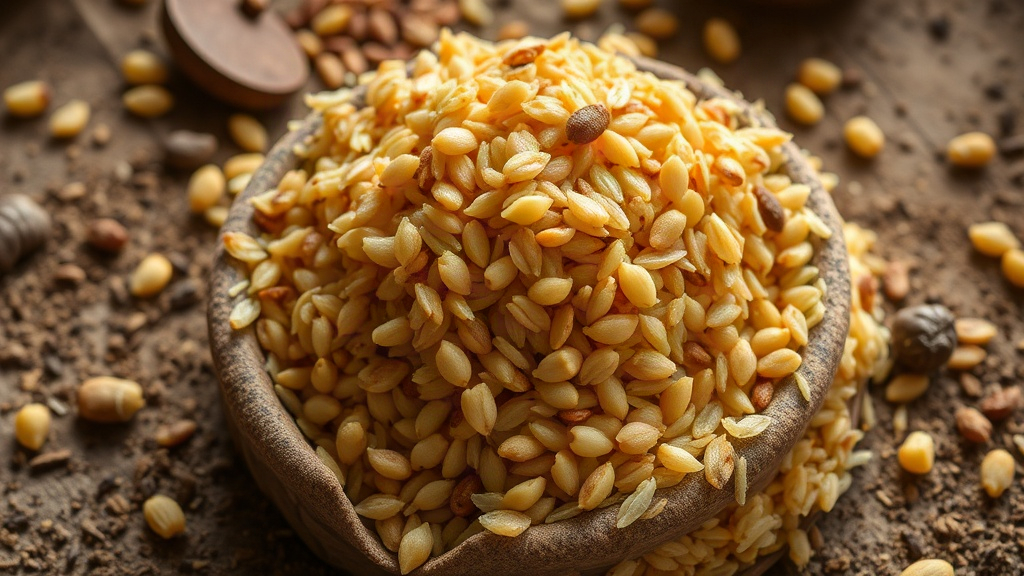
In the upper layers, which date to the height of the Anglo-Mysore Wars in the 1780s and 1790s, this botanical diversity disappears. Instead, the samples are dominated by a single crop: Oryza sativa (rice).
The sudden dominance of rice in the archaeological record of these dryland forts is striking. Rice is a water-intensive crop that was not widely grown on the dry hillsides surrounding these fortresses. Its presence in massive quantities inside the garrisons indicates that it was being brought in from elsewhere. It was a ration provided systematically by the state.
The Logistics of State-Rationed Rice
This dietary shift was the direct result of Tipu Sultan's administrative reforms. To maintain a standing army of tens of thousands of infantrymen, the Mysorean state bypassed local middlemen and created a centralized procurement system.
The state collected land revenue directly in the form of grain, particularly rice from the irrigated wet-land zones of the Kaveri River valley. This grain was transported under armed guard to state-run granaries located inside strategic fortresses.
By distributing rice instead of millets, the state provided a uniform, easily measurable ration to its troops. Rice was also faster to cook than whole-grain millets, a critical advantage for an army on the move. For the soldiers, eating rice—historically a prestigious grain associated with wealthy coastal regions and elite classes—was also a status symbol. It bound their loyalty directly to the ruler who provided it.
Yet, this transition came with risks. Unlike millets, which could survive in dry storage for years, rice was highly susceptible to moisture, pests, and rot in the humid conditions of southern India. The archaeological record shows that when British forces besieged and captured Mysorean fortresses, they often found the state granaries filled with spoiled, carbonized rice, victims of both dampness and the fires of bombardment.
Ultimately, the charred grains recovered from the hearths of these ruined forts reveal that the modernization of Mysore's army was not just a matter of adopting European weapons and tactics. It was a process that reshaped the very landscape of agriculture, transforming what the Deccani soldier ate, where his food was grown, and how he survived on the dry plateaus of the South.
References and Sources
- Fuller, D. Q., & Kingwell-Banham, E. (2014). The Economics of Crops and Cuisine in the Empires of Southern India. Journal of Interdisciplinary History, 45(1), 45-68.
- Weber, S., & Kashyap, P. (2010). The Archaeobotanical Record of the Deccan: Agriculture, Diet, and Society in Early Historic and Medieval South India. Archaeological and Anthropological Sciences, 2(3), 185-199.
- Morrison, K. D. (2009). Daroji Valley: Landscape History, State, and Society in the Vijayanagara Hinterland. Archetype Publications.
- National Center for Biotechnology Information (NCBI). Oryza sativa (rice) genomics and cultivation history database. NCBI Taxonomy.