The Ash of Watgal: What Ashmounds Reveal About Neolithic-Chalcolithic Coexistence in the Southern Deccan
Stratigraphic evidence from the Watgal ashmound in Karnataka challenges the narrative of sudden cultural replacement, revealing a long period of coexistence between early pastoralists and metal-using communities.

Rohan Bhattacharya for SwavedaAugust 11, 2026
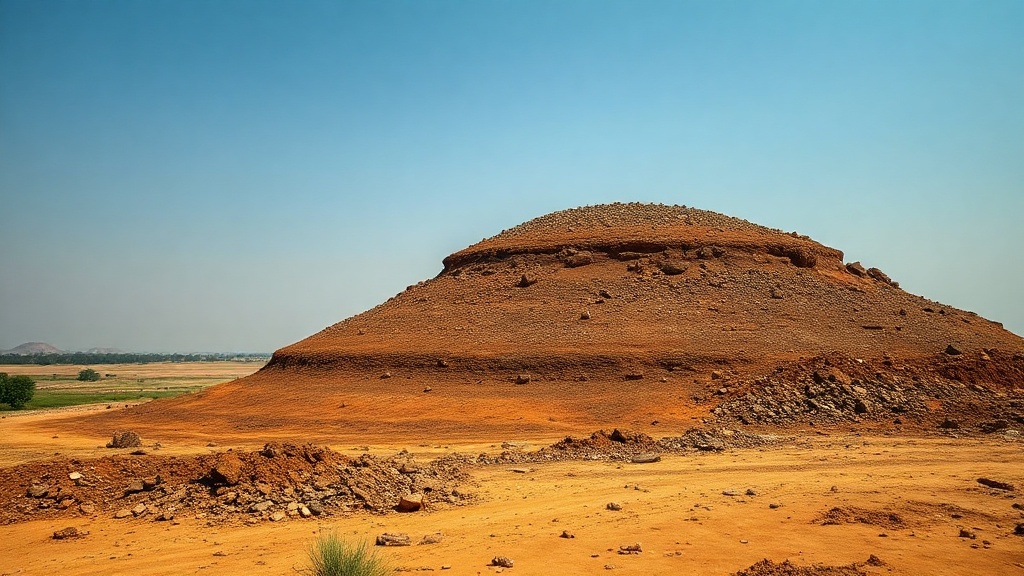
The ashmounds of the southern Deccan have long puzzled archaeologists. These massive, concrete-like mounds of vitrified cow dung, scattered across the dry plains of Karnataka and Andhra Pradesh, represent centuries of seasonal pastoral gatherings during the Neolithic period (approximately 3000 to 1200 BCE). For decades, standard historical narratives assumed that the transition from this pastoral Neolithic phase to the metal-using Chalcolithic and Iron Age cultures was sudden and disruptive. The arrival of copper and iron tools was presumed to have quickly displaced the older, dung-burning pastoral way of life.
However, careful stratigraphic work at the key site of Watgal, located in the Raichur district of Karnataka, challenges this model of sudden cultural replacement. Instead of a sharp break in the archaeological record, the earth layers reveal a complex, overlapping sequence. Here, the transition from the Neolithic to the Chalcolithic was marked by a long period of cultural coexistence and economic adaptation, rather than immediate displacement.
Decoding the Layers at Watgal
To understand this transition, archaeologists look to stratigraphy—the study of successive soil layers. In excavations conducted jointly by the Karnataka State Department of Archaeology and Museums and the American Institute of Indian Studies, researchers documented a continuous occupational sequence at Watgal. The reports, later discussed in journals like Man and Environment and the Indian Archaeological Society's Puratattva, outline a meticulous profile of the site's history.
The lowest occupational levels, designated as Occupation Phase I and II, represent the classic Southern Neolithic. These layers are dominated by handmade grey ware pottery, stone axes, and thick accumulations of decomposed and vitrified animal dung. The presence of vitrified ash—silica-rich dung that has melted under temperatures exceeding 1,200 degrees Celsius—points to the deliberate, high-temperature burning of accumulated livestock waste.
The crucial transition occurs in Occupation Phase III. In a sudden-replacement scenario, one would expect the dung layers and handmade grey pottery to vanish instantly, replaced by wheel-made Chalcolithic painted pottery and metal implements. Instead, the stratigraphy of Watgal reveals a different story.
The Coexistence of Clay and Metal
In Phase III, new material culture begins to appear in the soil profile. This includes wheel-turned black-on-red painted pottery, parallel-sided chert blades, and rare copper items, such as fishhooks and beads. Crucially, these early metal-age artifacts do not sit on a clean boundary line above the Neolithic material. They are found directly intermingled within the same stratigraphic layers as the traditional handmade grey ware.
Furthermore, micro-stratigraphic analysis shows that the accumulation of dung did not stop when copper arrived. The practice of penning cattle and occasionally burning the accumulated dung heaps continued alongside the introduction of new metallurgical technologies. The soil layers show thin, alternating bands of domestic refuse, hearth ash, and dung accumulations. This indicates that the community did not abandon its pastoral routines when it gained access to metal networks.
This mixed layer suggests a dual-economic model. Rather than one population driving out another, the existing Neolithic pastoralists likely integrated new trade items into their daily lives, or lived in close proximity to communities possessing metalworking skills. The introduction of copper did not immediately alter the fundamental pastoral economy of the Deccan.
Challenging the Replacement Narrative
The evidence from Watgal aligns with broader patterns observed in other regional reports by the Archaeological Survey of India (ASI) and academic publications such as Antiquity. Across many southern Deccan sites, the onset of the Chalcolithic is not marked by abandoned villages or burnt destruction layers. Instead, it is marked by the slow, organic adoption of new ceramic styles and small metal tools.
In the southern Deccan, copper was scarce and difficult to obtain. Unlike the Harappan zone to the northwest, where metal was abundant, Deccan communities used copper sparingly, primarily for small ornaments or specialized tools. The stone tool industry—specifically the production of microliths (small stone tools) and polished stone axes—remained the primary technology for daily tasks long after copper was introduced.
This slow technological shift explains why the ashmound tradition persisted. The ritual and practical aspects of dung burning, which served to clear pens of pests and perhaps mark territorial boundaries for seasonal herders, remained relevant even as wider trade networks began to bring copper into the Raichur Doab (the region between the Krishna and Tungabhadra rivers).
A Gradual Transition
The dry details of soil profiles at Watgal provide a necessary correction to dramatic historical theories. Rather than a sudden invasion or a rapid technological revolution that swept away older ways of life, the stratigraphy reveals a conservative, resilient pastoral tradition.
The people who accumulated the ash at Watgal did not disappear when the first copper fishhook arrived. Instead, the archaeological layers show that they incorporated new technologies at their own pace, maintaining their pastoral identity for generations in a changing economic landscape. This gradual blending of old and new remains the defining feature of the southern Deccan’s early history.