Spindle Whorls and Loom Weights: What Terracotta Tools Tell Us About Cotton Weaving in Early Historic India
Excavated spindle whorls and loom weights, not just texts, are how archaeologists reconstruct who spun and wove cotton in early historic India — and the tools raise more questions than they answer.

Kavya Sharma for SwavedaJuly 28, 2026
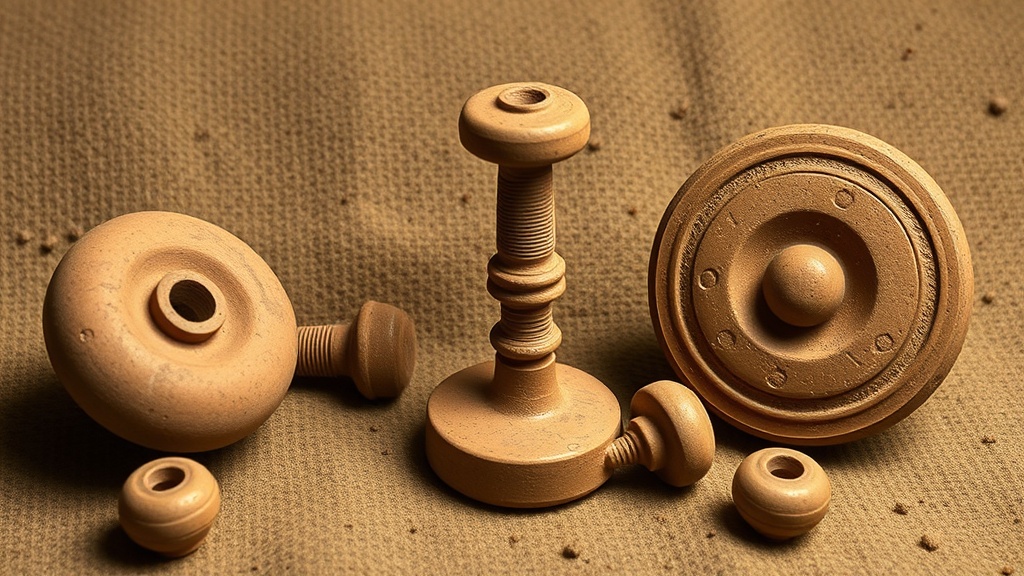
A spindle whorl is not much to look at. It is a small disc of fired clay, sometimes stone, usually no bigger than a large coin, with a hole punched through the centre. Push a wooden spindle through that hole, give it a spin, and the whorl's weight keeps the spindle turning long enough to twist loose cotton fibre into usable thread. That is the whole machine. No gears, no name plates, nothing written on it at all. And yet these small discs, dug up by the thousand from sites across the Indian subcontinent, are some of the most reliable evidence we have for a question textual sources answer only in passing: who actually made the cloth people wore.
The women's dress question — what early historic Indians wore, and who decided — tends to get argued from literature: court poetry, legal texts, religious commentary written by men who were rarely the ones spinning thread. Terracotta tools offer a different kind of witness. They don't tell you what people believed about weaving. They tell you where weaving physically happened, at what scale, and — with real limits — by whom.
What the whorls actually show
Spindle whorls survive in enormous numbers at Indus Valley sites because fired clay does not rot the way wood, cotton, and wool do. Chanhudaro, a Harappan-era site in Sindh excavated by Ernest Mackay in the 1930s, produced not just whorls but evidence read by researchers as a bead- and shell-working and craft-production centre, and cotton textile fragments recovered from Mohenjo-daro and related sites have been cited in the archaeological literature as among the earliest known cotton textile evidence in the world, dated to the third millennium BCE. The Harappa.com archive compiled by archaeologist Jonathan Mark Kenoyer documents spindle whorls, needles, and thread as part of the standard Indus craft-production toolkit found across multiple sites, not concentrated at one elite location — which is itself a finding. Cotton spinning does not look, in the archaeological record, like a specialist luxury craft confined to palace workshops. The tools are everywhere ordinary households were.
That distribution matters for the "who wove it" question. Textual traditions from later periods — Sanskrit and Prakrit literature, for instance — associate spinning with women's domestic labour, and ethnographic and historical studies of spinning technology across South Asia generally treat the drop spindle as women's work performed alongside other household tasks, in contrast to loom weaving, which in many regions and periods involved men working in dedicated workshops or as a specialised trade. Archaeologists reason from this pattern, cautiously: if whorls appear scattered through domestic floor levels of houses rather than clustered in workshop debris, that distribution is consistent with spinning as everyday household work rather than an organised guild trade. Loom weights — heavier terracotta or stone objects used to keep warp threads taut on a vertical loom — tend to show a different distribution when they appear, often clustered, which some excavators read as evidence of dedicated weaving areas rather than universal household activity. This is an inference from find-context, not a labelled artefact, and it is worth being honest about that gap.
Tradition, evidence, and the limits of clay
This is where the registers need separating carefully. Evidence shows that spindle whorls are common, durable, and widely distributed across excavated household contexts at Indus and later Chalcolithic (copper-age) sites. Tradition holds — meaning later texts and oral custom, not the tools themselves — that spinning was gendered women's labour. Scholars debate how far back that gendering can be pushed using material culture alone, because a whorl found on a floor does not carry a fingerprint or a name. Some researchers use whorl size and weight distributions to infer what fibre and thread thickness was being spun (finer whorls for finer thread), which is a genuinely testable material claim. Assigning a gender to the hand that turned it is a much harder inference, borrowed largely from ethnographic parallels with more recent spinning communities and from textual mentions, not read directly off the clay.
Why the coin-sized object still matters
The honest answer to "how do we know who wove cotton in early historic India" is: we don't know with certainty, but the terracotta record narrows the guesswork. It tells us spinning was widespread rather than centralised, that it left traces in ordinary homes rather than only specialist workshops, and that cotton processing was already a developed technology in the third millennium BCE at Indus sites — centuries before the literary sources usually cited on women's dress and domestic labour were composed. A spindle whorl can't quote a woman spinning thread in her courtyard. But it can tell you the courtyard had a spindle in it, which is more than most texts bother to record.