Silver and Seaports: Reassessing Roman Coinage at Arikamedu
The presence of Augustan and Tiberian denarii at Arikamedu offers a tangible record of trade. We map this numismatic evidence against the maritime accounts of the Periplus.

Devika Menon for SwavedaJuly 22, 2026
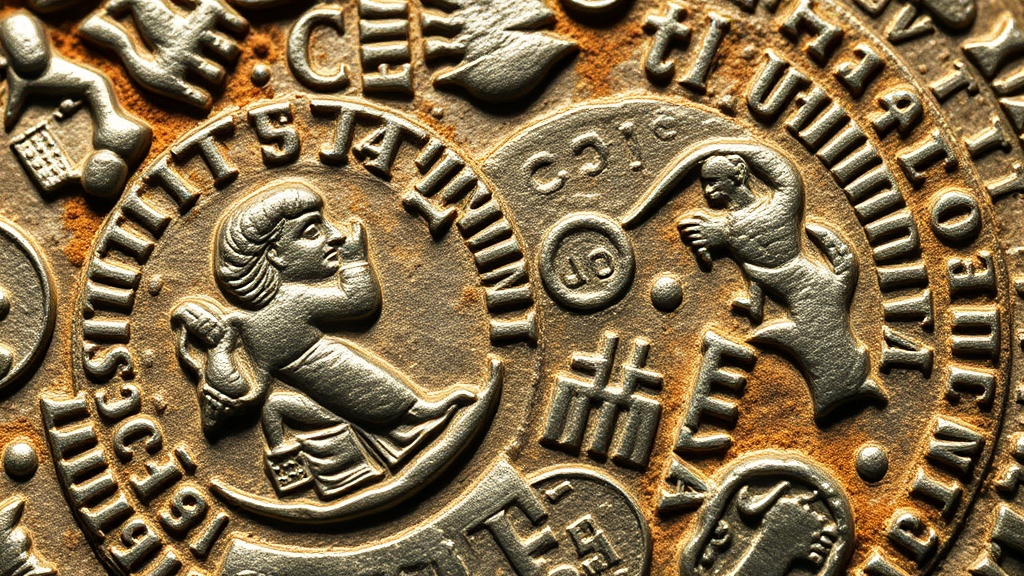
The site of Arikamedu, located near the modern city of Pondicherry, remains the most significant archaeological anchor for understanding Indo-Roman trade. Excavations, most notably those conducted by Sir Mortimer Wheeler in 1945, uncovered a stratified sequence of occupation that confirms the presence of Roman material culture in a Tamil context. Among the most diagnostic artifacts are the silver denarii (a standard Roman silver coin) bearing the portraits of the Emperors Augustus and Tiberius.
The Numismatic Record
Numismatics, the study of currency, provides a rigid chronological framework that pottery styles alone cannot always supply. At Arikamedu, the recovery of Augustan and Tiberian denarii indicates a consistent pulse of exchange during the early first century CE. These coins were not merely bullion; they functioned as high-value currency within the Roman sphere, yet their presence in South India suggests they arrived as part of a sophisticated mercantile system.
According to archaeologist Vimala Begley, the distribution of these coins is concentrated in the northern sector of the site, designated as the "Warehouse." The rarity of coins from later imperial reigns in these specific strata suggests that the primary intensity of this trade connection occurred during the Julio-Claudian period. This aligns with the evidence of Arretine ware—a specific type of red-gloss pottery manufactured in Italy—found in the same layers.
Mapping the Periplus
The Periplus of the Erythraean Sea, a Greek-language portolan (a navigation manual) written by an anonymous merchant likely in the first century CE, identifies a site called Poduke. Scholars widely equate Poduke with Arikamedu due to its geographical alignment and the sheer volume of Mediterranean artifacts found there.
The Periplus records that ships from Egypt sailed to the ports of the Tamil kings, specifically noting the export of spices, pearls, and textiles. The text explicitly mentions that trade was conducted for "Roman gold and silver currency," which corroborates the physical evidence of the denarii found in the coastal Tamil country. While tradition holds that Roman coins were used for local currency in South India, the archaeological reality suggests they functioned primarily as commodity money—valued for their silver content—rather than as circulating legal tender within the domestic Tamil economy.
Assessing the Trade Dynamics
The presence of these coins does not imply Roman political influence or settlement in the modern sense. Instead, it reflects a merchant-led network. The coinage serves as a chronological marker for when these trade routes were at their most active.
Evidence shows that the flow of silver denarii diminished significantly toward the middle of the first century CE, replaced partially by an influx of Roman aurei (gold coins) and, eventually, by local imitation coinages. This shift coincides with changes in the maritime routes described in later Roman sources, which suggest that ships began to favor ports further down the Malabar coast to better access the pepper trade.
Scholars debate whether the decline in denarii at Arikamedu represents a sudden severance of trade or a gradual diversification of port locations. When comparing the coin finds at Arikamedu to the vast hoards found in the Coimbatore gap—inland caches containing hundreds of Roman coins—the coastal site appears as a point of transit rather than a center of accumulation. The denarii are found in fewer numbers than in the inland hoards, reinforcing the idea that Arikamedu acted as an entrepôt (a commercial trading center) for goods moving between the maritime corridors of the Bay of Bengal and the interior markets of the Tamil kingdoms.
The physical evidence from Arikamedu remains a critical benchmark for the historian. By pinning these strata to the reigns of specific emperors, we move from vague notions of "ancient trade" to a concrete timeline. The silver of Augustus and Tiberius provides the date, while the Periplus provides the logistics, creating a coherent picture of a maritime world that connected the Roman Mediterranean to the Sangam-era Tamil ports.