What Ancient Indian Women Wore: Evidence from Sculpture and Text
What did women wear in ancient India—and how do we know? Sculpture, frescoes, and Sanskrit texts describe garments from 300 BCE to 600 CE across North and South India. Evidence, not myth.

Meera Iyer for SwavedaJuly 7, 2026
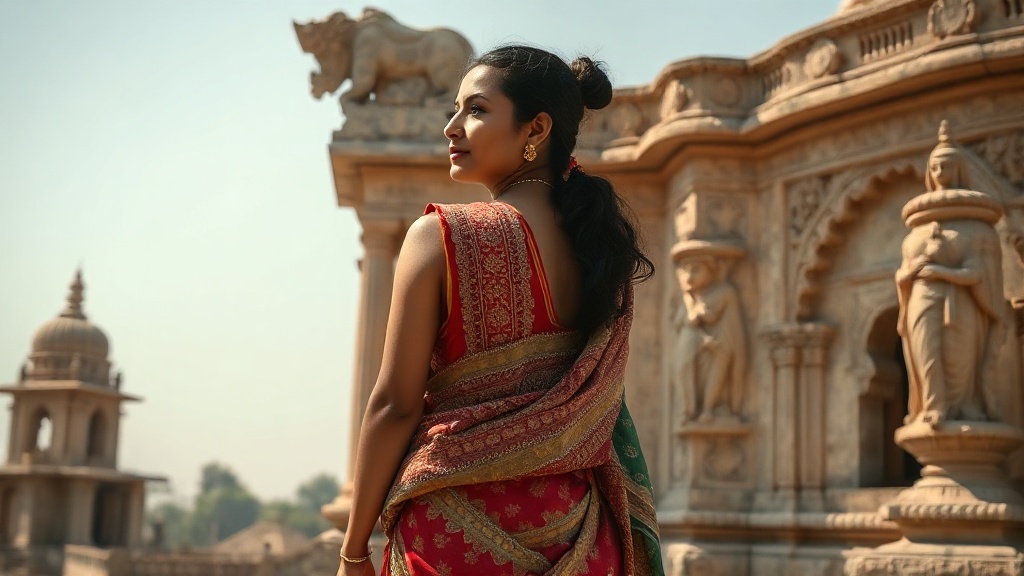
Claims frequently circulate about the attire of women in ancient India, often portraying common women as routinely wearing garments that were sleeveless, backless, and lacked any form of blouse or bodice. These depictions, sometimes presented as definitive, invite closer scrutiny. This report examines available evidence from visual arts and textual records to understand the realities of women's dress during ancient periods in the Indian subcontinent, focusing on the timeframe of roughly 300 BCE to 600 CE and spanning both North and South India.
Temple sculptures offer a rich visual archive, but their interpretation requires careful consideration. Many sculptures, particularly those from the Gupta period (c. 320-550 CE) and earlier, depict female figures adorned in elaborate jewelry and garments. The common representation shows women wearing a lower garment, often a dhoti (a length of unstitched cloth wrapped around the waist and legs) or lehanga (a skirt-like garment), and an upper garment. This upper garment frequently appears as a choli or kancuka (a type of blouse or bodice), or a sash wrapped around the torso.
For example, the detailed reliefs at Sanchi (3rd century BCE - 11th century CE) depict numerous female figures. While some wear distinct upper garments, others are depicted with torsos less covered, particularly those in dance or devotional poses. The Sangam literature of Tamil Nadu, dating roughly from 300 BCE to 300 CE, provides further textual evidence from South India. Poems within collections like the Patiṟṟuppattu and Aka Nāṉūṟu describe various garments. While often focusing on the beauty of women, these texts mention garments that cover the chest. For instance, the term tirumukam could refer to a garment worn on the upper body, and descriptions of women's adornments frequently include items that would be worn over or around the chest area.
However, some sculptures, especially those focusing on dancers, celestial beings (apsaras), or deities, portray upper bodies with minimal or no covering beyond elaborate ornamentation. The detailed reliefs at the Konark Sun Temple (13th century CE) include many female figures. While some wear distinct upper garments, others are depicted with torsos primarily covered by necklaces, girdles, and armbands, with the breasts bare. These depictions, however, represent idealized or ritualistic contexts rather than the everyday wear of all women. The question remains whether such depictions reflect the daily attire of ordinary women or specific, perhaps more public or performance-oriented, contexts. Ajanta frescoes, for example, show a variety of upper body coverings for women, ranging from elaborate draped sashes to more fitted bodices, depending on the context and social status depicted. This variation highlights that interpretations must account for regional differences and specific artistic intentions.
The interpretation of these visual records is complicated by the nature of sculpture itself. Sculptors often sought to convey idealized beauty, divinity, or status through their art. The emphasis might not always be on sartorial realism for the general populace. Furthermore, the passage of time can affect the perception of these carvings; what might have been clear in its original context could be obscured by weathering or the artist's stylization.
Textual evidence provides another layer of understanding. Ancient Sanskrit literature, for instance, describes various garments. The Mahabharata and the Ramayana, epic poems composed over centuries, contain descriptions of clothing. Terms like uttariya (an upper garment or shawl) and antariya (a lower garment) are found. The existence of kancuka (a jacket or bodice) or stanapatta (a breast band or sash) is also mentioned in some texts, suggesting a practice of binding or covering the chest.
For example, the Arthashastra of Kautilya, a treatise on statecraft likely compiled in the 4th century BCE, details various fabrics and clothing items used in the Mauryan empire. While not always explicitly detailing women's attire in specific contexts, it alludes to the existence of different types of garments. Pāli literature, from early Buddhist canons, also offers insights. The Jatakas, tales of the Buddha's previous lives, describe attire for men and women. While some descriptions can be generalized, they often point to the use of cloths wrapped around the body in various ways, including coverings for the upper body.
Scholarly interpretations of these texts and sculptures have varied. Some scholars, focusing on the more sparsely clad figures in certain sculptures, have suggested a greater degree of exposure in ancient Indian attire, particularly for women. Others emphasize textual references to upper garments or breast bands as evidence for more modest dress among the general population. The debate often hinges on which representations are considered normative and which are exceptional or symbolic.
It is important to distinguish between different social strata and regions. What was worn by women in royal courts, elite households, or specific professional groups might differ significantly from the attire of rural women or those engaged in manual labor. Climate, local customs, and available materials also played a role in shaping dress.
A critical examination suggests that while some ancient Indian art and texts depict women with bare upper bodies, this may not represent the routine attire of all common women between 300 BCE and 600 CE. The presence of terms for upper garments and breast bands in literature, alongside sculptures showing more complete attire, indicates a range of practices. It is possible that in certain regions or for certain activities, sleeveless and blouse-less garments were worn, or that the upper body was primarily covered by a sash or shawl (uttariya). However, a blanket assertion that common women universally wore such outfits daily lacks robust, consistent evidence across all periods and contexts. The visual and textual records present a more complex picture, reflecting diverse customs and evolving styles rather than a single, uniform mode of dress.
Archaeological findings, though often fragmentary, offer tangible proof of textile use. Excavations at sites like Arikamedu (dating from c. 300 BCE to 300 CE), a Roman trading post, have yielded evidence of dyed fabrics. While specific garment reconstructions are challenging, these finds confirm the use of textiles for clothing. Similarly, terracottas from various sites across the subcontinent often depict figures in full or partial dress, providing additional visual data. The challenge lies in correlating these fragments with specific social groups and daily life versus ceremonial occasions. The evidence consistently points towards a variety of upper body coverings, from intricately draped sashes to more fitted kancuka or choli, depending on time, place, and social context.
The common notion of women routinely going shirtless in ancient India, while present in some artistic renderings, is not universally supported by the totality of evidence from 300 BCE to 600 CE. The combined testimony of sculpture, literature, and archaeology suggests a more nuanced reality where modesty and practicality influenced dress, alongside aesthetic and ritualistic considerations.