Measuring the Walls: What House Sizes Tell Us About Inequality in Mohenjo-daro
Archaeologists use house floor areas to estimate wealth distribution in ancient cities. A look at the method reveals how Mohenjo-daro's housing gap actually shrank over time.

Kavya Sharma for SwavedaJuly 26, 2026
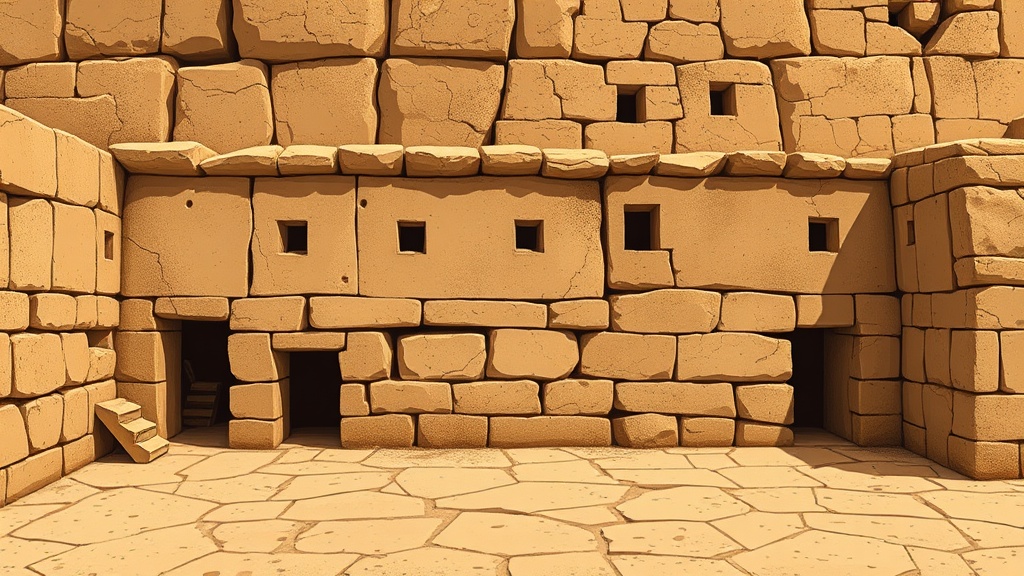
How do you measure the gap between the rich and the poor when the society in question left behind no tax ledgers, no written wills, and no currency?
This is the puzzle of the Indus Valley Civilization. At its peak, cities like Mohenjo-daro, located in modern-day Pakistan, housed tens of thousands of people. Yet, unlike their contemporaries in Egypt or Mesopotamia, they left no grand royal tombs, no monumental statues of kings, and no obvious palaces. To understand how wealth was shared among its citizens, archaeologists must look at the most basic unit of urban life: the family home.
A research project published on Harappa.com analyzed how the distribution of residential house sizes in Mohenjo-daro changed over centuries. By measuring the floor areas of preserved homes, researchers attempted to calculate the city's Gini coefficient—a standard statistical measure of inequality where 0 represents perfect equality and 1 represents absolute inequality. The results suggest that, contrary to the typical trajectory of growing ancient empires, inequality in Mohenjo-daro actually declined over time.
But how reliable is a house as a proxy for a bank account, and what does this method miss about daily life in the Indus Valley?
The Mathematics of Brick and Mortar
In modern economics, census data and tax returns make it easy to map wealth. For antiquity, archaeologists rely on proxies. The house-size method operates on a simple assumption: wealthier households build larger homes.
To map this in Mohenjo-daro, researchers looked at the preserved ground-floor footprints of residential blocks across different chronological phases of the city. In the early days of archaeological excavation, pioneers like John Marshall and Ernest Mackay cleared large swathes of the city, mapping hundreds of structures. Modern researchers used these detailed architectural plans to measure individual household plots.
The study analyzed house sizes across three distinct occupational phases: the Late II phase (the youngest, closest to the surface), the Late I phase, and the Intermediate I phase (an older, deeper layer). By calculating the Gini coefficient for each period, the study revealed a surprising trend. In the older Intermediate I phase, the Gini coefficient for house sizes was 0.44. In the subsequent Late I phase, it dropped to 0.38. By the final Late II phase, it fell further to 0.28.
For context, a Gini coefficient of 0.28 is remarkably low. It is comparable to the income distribution of modern Scandinavian nations, suggesting an urban society where housing space was distributed with surprising equity. The evidence shows that over time, the gap between the largest houses and the smallest houses in Mohenjo-daro got smaller, not larger.
What a Floor Plan Conceals
While the downward trend in the Gini coefficient suggests a leveling of wealth, the house-size method has inherent limitations.
First, a two-dimensional floor plan only tells part of the story. Many houses in Mohenjo-daro had staircases, indicating the presence of a second story or usable flat roofs. If wealthier families expanded upward rather than outward, a flat map of the ground floor would underestimate their actual living space.
Second, house size does not automatically correlate with household wealth. In many traditional societies, large houses do not signify a single wealthy owner, but rather a multi-generational joint family sharing resources. Conversely, a small, single-room structure might house a highly skilled artisan who possessed valuable trade goods but required little physical space.
Scholars debate whether the shrinking house sizes in the later phases of Mohenjo-daro represent a triumph of egalitarian planning or a symptom of urban decay. During the Late Period, the grand civic infrastructure of Mohenjo-daro began to decline. Large courtyards were subdivided by crude brick walls to accommodate more families. Courtyards that once served single households were carved up into smaller tenements.
In this light, a falling Gini coefficient might not mean the poor were getting richer. Instead, it could mean the wealthy were losing their estates, forcing everyone into crowded, similarly sized quarters as the city's economic networks fractured.
The Portable Wealth Factor
To build a complete picture of ancient inequality, archaeologists must cross-reference house sizes with what was found inside the walls.
Mohenjo-daro was a city of makers. Its lanes were filled with workshops producing carnelian beads, glazed faience (a ceramic-like material made from crushed quartz), shell bangles, and bronze tools. Unlike Egypt, where precious metals were buried in royal tombs, the luxury goods of the Indus Valley are found scattered throughout ordinary residential quarters.
Even in smaller homes, excavators have recovered finely polished weights, painted pottery, and sophisticated personal ornaments. This suggests that while housing space might have been constrained, access to utilitarian and decorative goods was widely distributed among the urban population.
The house-size method provides a valuable, measurable starting point for studying ancient social structures. It proves that Mohenjo-daro avoided the extreme spatial inequality seen in other Bronze Age capitals, where tiny hovels sat in the literal shadows of massive palaces. However, the true measure of Indus equality remains a complex puzzle—one written not just in the footprint of brick walls, but in the distributed remnants of daily labor, craft, and trade.