The Sothi-Siswal Horizon: How Early Farmers Settled the Ghaggar-Hakra Plain (c. 3500–2600 BCE)
Before the Indus cities fell, smaller farming settlements dotted the Ghaggar-Hakra river system. Archaeology shows how people adapted to changing climate and settlement patterns over 500 years.
Rohan Bhattacharya for SwavedaJuly 26, 2026
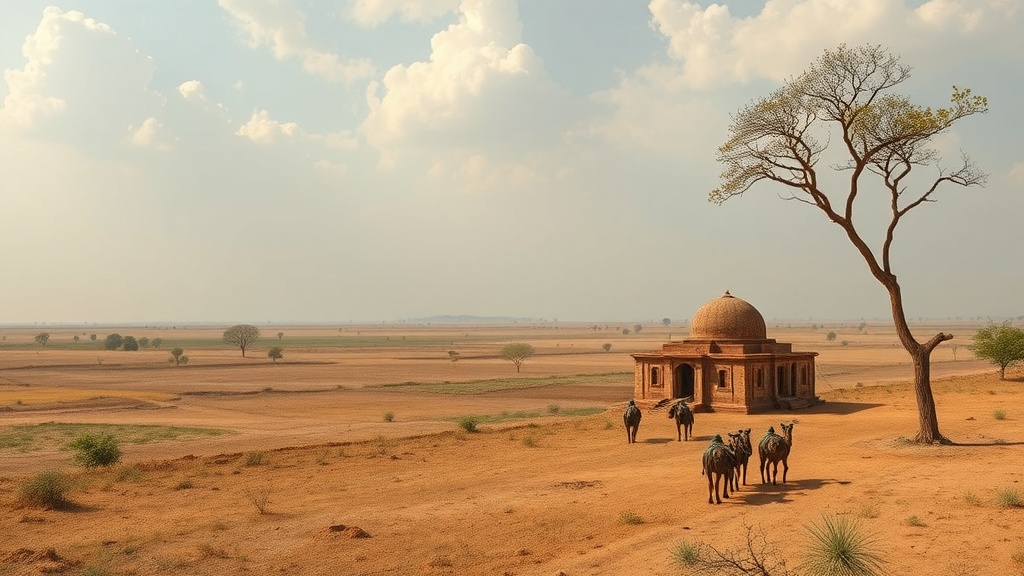
At Rakhigarhi, in Haryana, excavators cutting through a habitation mound found something that rarely makes a headline: a buried hearth, ringed with ash, sitting just beneath the foundation trench of a later, more solidly built house. That hearth belongs to what archaeologists call the Sothi-Siswal Horizon — a term for a layer of settlement, roughly 3500 to 2600 BCE, when farming communities lived along the Ghaggar-Hakra river system in what is now Haryana and Rajasthan, well before the rise of full Indus cities like Mohenjo-daro and Harappa. "Horizon" here means a distinct chronological layer in the soil, identified by its own pottery style and building methods — not a claim about how far it spread geographically.
This matters because the Sothi-Siswal Horizon is the direct ancestor of the Mature Harappan phase, the urbanized period most people picture when they hear "Indus Valley Civilization." Understanding how one became the other — over centuries, not overnight — is the real story buried in these mounds.
Where and When
The Sothi-Siswal culture takes its name from two sites, Sothi in Rajasthan and Siswal in Haryana, both on the now largely dry Ghaggar-Hakra river system. It is defined by a specific ceramic assemblage: incised designs and a red-slipped pottery style distinct from later Harappan wares. As V.N. Misra and R.S. Bisht note in Indus Civilization, pinning down exactly where this early regional culture ends and the Mature Harappan phase begins requires precise stratigraphic control — reading the layers in a trench wall like pages in a book, in order, without skipping any.
That distinction rarely arrives as a clean break. In an actual trench section, you see overlapping layers where early local techniques persist even as newer, more standardized urban styles start to dominate the record.
Refining the Timeline
Chronology has long been the sticking point for archaeologists working this plain. Older models leaned on relative dating — comparing pottery styles across sites — which left real gaps. Accelerator Mass Spectrometry (AMS) radiocarbon dating, which measures the decay of carbon-14 in organic material like charred grain or charcoal, has narrowed those gaps considerably. Recent work at Rakhigarhi, led by Vasant Shinde and colleagues in PLOS ONE, has given researchers a firmer chronological framework for this site specifically.
By dating habitation deposits at Rakhigarhi, Shinde's team was able to correlate specific ceramic phases with the onset of Mature Harappan urbanism. Their data shows early habitation reaching back into the Early Harappan period, with a gradual transition into the mature phase — visible in changing construction techniques and settlement layout, not a sudden replacement. Urbanism here looks like a local evolution stretched over several centuries, not an abrupt arrival.
Excavations at Girawad, reported by the Archaeological Survey of India in Indian Archaeology: A Review, tell a similar story. Sothi-Siswal traits persist into the earliest urban levels there. Older ceramic forms don't vanish; they linger, blending with the emerging Harappan style. That pattern points to a period of synthesis — local communities adopting new administrative or trade practices while keeping their domestic pottery traditions intact.
The Problem of Disturbed Soil
A persistent headache in the Ghaggar-Hakra plain is the soil itself. These sites are prone to vertical displacement from rodent burrowing, water table shifts, and later occupation layers pressing down on earlier ones. Several authors in Puratattva have written about bioturbation — the mixing of sediment by living organisms — and how it can compromise thin, early layers.
When an excavator reports a "Sothi-Siswal layer," they're often describing a composite: fragments trapped in sediment that has seen thousands of years of disturbance. That's why the field has shifted toward closed-context finds — a hearth, a sealed pit, a foundation trench — as reliable radiocarbon samples. These features help researchers avoid intrusive material: artifacts from a later period that have worked their way down into an older layer and skewed the dates.
A Skeptical View of "Transition"
Calling a site "Early Harappan" or "Mature Harappan" is a taxonomic convenience, and evidence shows it can flatten a messier reality. The Sothi-Siswal population didn't vanish or get replaced. Tradition holds that these communities were the architects of their own transition, reorganizing labor and resources as settlements grew, while their tools and pottery kept a sustained regional identity.
Scholars debate the pace of that change. Some point to rapid shifts in city layout as evidence of a sudden administrative reorganization. Others, reading the ceramic record and the slow accretion of site growth, argue for gradual internal maturation. The Rakhigarhi data leans toward the latter — an organic, homegrown model of urban development.
The next useful work here won't come from grand pronouncements. It will come from the boring details: slip thickness on a pot sherd, the mineral makeup of a mud brick, the exact stratigraphic depth of a single charred barley grain. That's where the real history of the Ghaggar-Hakra plain sits — not in a sudden rise, but in five centuries of quiet, dusty accumulation.