Kurukshetra: Mapping the Mahabharata’s Geography Against the Archaeological Record
We examine the intersection of the Mahabharata’s traditional geography and the archaeological reality of Painted Grey Ware culture in the Kurukshetra region.

Vikram Joshi for SwavedaJuly 20, 2026
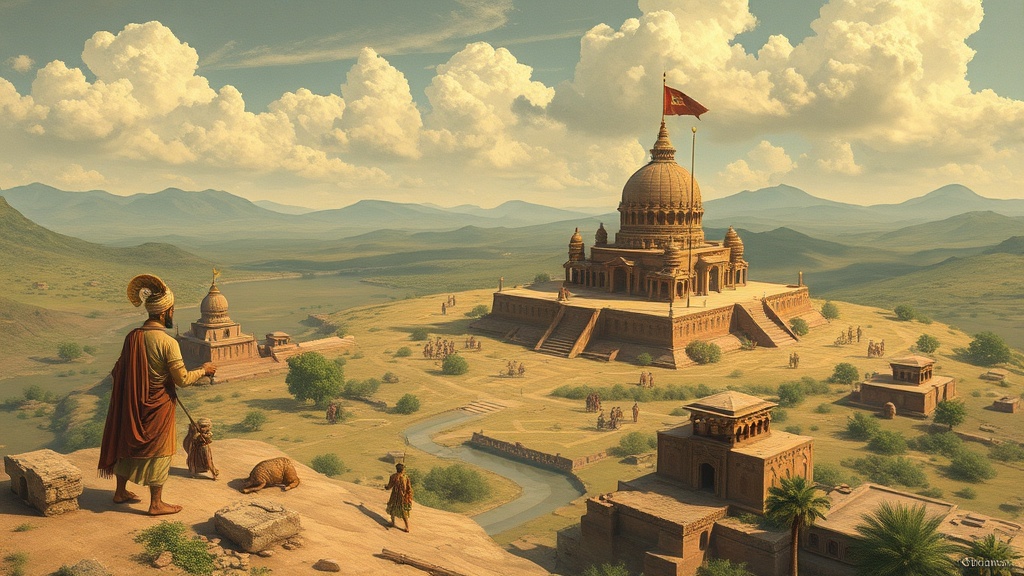
The identification of Kurukshetra—the central stage of the Mahabharata—as a specific historical coordinate remains one of the most persistent inquiries in Indian historiography. Tradition holds that the events of the epic unfolded on these plains. However, distinguishing between the literary landscape described in the Sanskrit texts and the physical remains unearthed by archaeologists requires a disciplined approach to both primary sources and field data.
The Literary Landscape
The Mahabharata describes Kurukshetra as a sacred expanse (dharmakshetra or "field of righteousness") located in the northern region of the Indo-Gangetic divide. In the text, the geography serves a symbolic and narrative function, anchoring the Kaurava-Pandava conflict in a place already imbued with ritual significance. The epic mentions specific landmarks, such as the Sarasvati River, which historically flowed through this region before environmental shifts led to its fragmentation and eventual drying of segments of its course.
Archaeologists have long sought to align these textual descriptions with physical sites. The primary material culture associated with the timeframe often linked to the Mahabharata is the Painted Grey Ware (PGW) culture. PGW is a ceramic tradition characterized by grey-colored pottery painted with geometric patterns in black or dark brown.
The PGW Horizon
Excavations at sites across the Indo-Gangetic plain, such as Hastinapura, Ahichchhatra, and Bhagwanpura, have revealed distinct occupational layers defined by this specific pottery. According to the Archaeological Survey of India (ASI), these PGW sites generally date from the late second millennium BCE to the middle of the first millennium BCE.
At Hastinapura, the site most frequently associated with the Kuru capital, excavator B.B. Lal identified an occupational sequence that placed the PGW culture above earlier deposits. Lal argued for a broad chronological correlation between the PGW culture and the Mahabharata narrative. However, this synchronization is not a consensus. Scholars debate whether the presence of PGW pottery at a site constitutes proof of the historical epic. As Upinder Singh notes in her survey of ancient India, the "historical core" of the Mahabharata—if one exists—likely reflects a memory of tribal conflicts that took place within the context of the Iron Age transition, rather than a record of a single, localized cataclysmic battle.
The Challenge of Synchronization
The primary difficulty in linking the battle to specific archaeological strata is the disparity between literary time and radioactive decay. Radiocarbon dating provides a range for when people lived at these sites, but it cannot identify the specific events described in the poetry.
Furthermore, the sites identified as "Mahabharata cities" often yield relatively modest material remains. The settlements are typically characterized by mud-brick structures and agricultural tools, which contrasts with the grand urban centers described in the text. Romila Thapar suggests that the epic underwent multiple phases of composition over several centuries. Consequently, the geography of the poem may represent a composite of the cultural knowledge available to later editors, rather than an eyewitness map of the Bronze or Iron Age Kurukshetra.
Distinguishing Tradition from Evidence
Evidence shows that the Kurukshetra region was a hub of settlement during the period when PGW culture flourished. Archaeological excavations, such as those documented in Indian Archaeology: A Review, have cataloged numerous settlements in the Sarasvati-Drishadvati valleys. These confirm that the region was densely populated and economically active.
However, tradition holds that the battle occurred at a specific site at a specific time. Scholars debate the accuracy of this claim, pointing out that there is no archaeological signature—such as a layer of destruction, a massive cache of weaponry, or defensive fortifications—that definitively marks a battle of the scale described in the Mahabharata.
When analyzing these sites, researchers must distinguish between three registers:
- The Epic Register: The narrative world of the Mahabharata, where geography functions as a stage for moral and martial conflict.
- The Archaeological Register: The actual distribution of artifacts like PGW, which tell us about the settlement patterns, trade, and daily lives of the people who inhabited the Gangetic plains.
- The Interpretive Register: The attempt by historians to bridge the two, which remains a field of active and healthy disagreement.
The quest to find the "battlefield" often overlooks the historical value of the sites themselves. Whether or not a specific battle occurred at Kurukshetra, the archaeological record confirms that the region was a crucible of social and political evolution during the formative stages of early Indian civilization. By moving away from the need to "prove" the epic, researchers gain a clearer understanding of the actual societal shifts—such as the transition to iron technology and the expansion of agriculture—that defined the lives of the people who eventually told the story of the Kuru war.
The relationship between the Mahabharata and the archaeology of the Indo-Gangetic divide remains a study in contrasts. While the physical landscape offers clear evidence of long-term human habitation and cultural development, the epic remains a distinct layer of historical memory, shaped by generations of transmission that prioritized thematic truth over geological and chronological precision.