Herostones: Echoes of Warrior Veneration in South and Central India
Viragallu, or herostones, offer tangible evidence of warrior commemoration, local governance, and societal values in historical South and Central India.

Meera Iyer for SwavedaJune 16, 2026
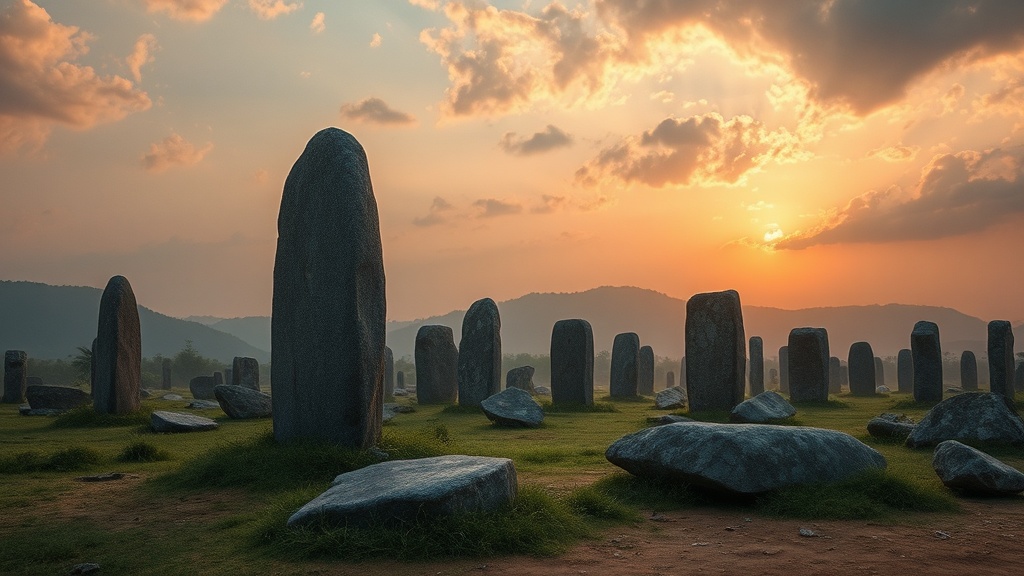
The landscape of South and Central India is punctuated by silent sentinels: carved stones that speak of lives lived and deaths in battle. These are the viragallu (વીરગಲ್ಲು), or herostones, a material testament to the practice of warrior veneration, local governance, and the values embedded in these societies. Unlike hagiographies or chronicles that survive through textual transmission, viragallu offer a direct connection to the past, their inscriptions and iconography providing a rich source for historical reconstruction.
The term viragallu itself is a Sanskrit compound. Vīra (वीर) translates to "hero" or "warrior," and śilā (शिला) or kallu (ಕಲ್ಲು in Kannada, a related Prakrit form) means "stone." The compound vīraśilā (वीरशिला) or vīrakallu (વીરકಲ್ಲು) thus denotes a stone erected in honor of a hero. These stones were not merely markers of death; they were active sites of remembrance and, in some cases, veneration. The practice, while most prominent in specific periods, has deep roots and demonstrates remarkable continuity across centuries.
The archaeological evidence suggests that the earliest forms of hero commemoration in India date back to the Neolithic period. However, the viragallu tradition as we commonly understand it, characterized by intricate carvings and detailed inscriptions, gained significant traction from the early centuries CE onwards, particularly flourishing during the eras of the Satavahanas, Kadambas, Chalukyas, Rashtrakutas, and the Vijayanagara Empire. The geographical spread is substantial, with notable concentrations found in regions like Karnataka, Andhra Pradesh, Telangana, and parts of Maharashtra and Tamil Nadu.
These stones typically depict a warrior, often shown in the act of fighting, dying, or ascending to heaven. The iconography is crucial: a hero might be shown with a sword and shield, engaged with an enemy, or being carried aloft by celestial beings, often apsarases, signifying his journey to the divine realm. This imagery is not merely decorative; it conveys a specific message about the warrior's valor and the reward for his sacrifice. The hero’s ascent to svarga (स्वर्ग), the heaven of the gods, was a potent symbol of eternal glory and a powerful incentive for others to emulate his bravery.
The inscriptions on viragallu are often in Prakrit, Sanskrit, or regional Dravidian languages like Kannada and Tamil. These epigraphs provide invaluable data, detailing the name of the hero, the circumstances of his death, the date (though precise dating can sometimes be challenging), and the purpose of the stone's erection. Many inscriptions explicitly state that the stone commemorates a warrior who died defending his village, his king, or in the course of a raid or battle. This directly links the viragallu to the socio-political structures of the time, highlighting the importance of martial prowess and protection.
Beyond commemorating individual acts of heroism, viragallu offer insights into local governance and societal structures. Inscriptions sometimes mention the village council or local chieftains responsible for erecting the stone, indicating a form of community acknowledgment and memorialization. The sacrifice of a hero could thus be seen as an investment in the safety and continuity of the community, elevating the fallen warrior to a protector figure. This practice can be understood as a localized form of ancestor worship, where the deeds of the heroic dead continued to be honored and remembered, reinforcing social bonds and martial traditions.
The textual evidence from early Indian literature, while not always directly referencing viragallu, supports the cultural milieu in which they were created. The Mahabharata, for instance, is replete with narratives of heroic battles and the valor of warriors. The concept of dharma (धर्म) played a significant role, with the warrior's duty to fight for righteousness and protect the weak being paramount. The erection of a viragallu can be seen as a tangible manifestation of this ideal, immortalizing those who upheld it on the battlefield.
Scholarly interpretation of viragallu continues to evolve. While early interpretations often focused on their purely martial aspect, more recent studies have explored their function in community building, the articulation of local power structures, and the negotiation of social status. The stones served not only to honor the deceased warrior but also to assert the importance of the lineage or community from which he came. They are, in essence, historical documents etched in stone, offering a unique perspective on the lives, deaths, and enduring legacies of those who defended and shaped their societies.
The careful examination of these carved stones, their inscriptions, and their archaeological context allows us to move beyond generalized narratives of ancient India. Each viragallu represents a specific life, a particular moment of conflict, and a community's enduring memory. They stand as a powerful reminder that history is not solely written in texts, but is also preserved in the enduring forms of stone and memory.
Summary: Herostones, or viragallu, in South and Central India are inscribed stone monuments commemorating fallen warriors, providing evidence of their martial valor, societal values, and local governance from early centuries CE onward.