From Seringapatam to Waterloo: An Empire's Echo in a Tamil Town
Discover the unlikely historical threads connecting India's Battle of Seringapatam, Napoleon's defeat at Waterloo, and the naming of Wellington, a town in Tamil Nadu.

Vikram Joshi for SwavedaJuly 13, 2026
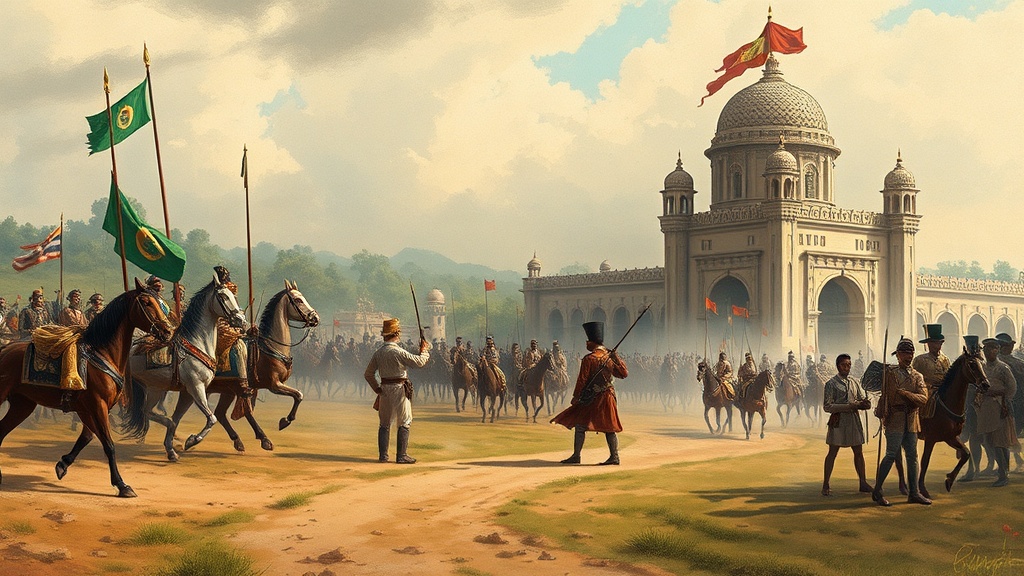
The name Wellington evokes images of Napoleonic battlefields and a resolute British commander. Yet, the echoes of Arthur Wellesley, later the Duke of Wellington, reverberate not only across Europe but also in the heart of Tamil Nadu, India. This story traces an unexpected historical lineage, linking the decisive Siege of Seringapatam in 1799 to the pivotal Battle of Waterloo in 1815, and culminating in the naming of a small town: Wellington, India.
The connection begins with the formidable Kingdom of Mysore and its ruler, Tipu Sultan. Tipu, known as the "Tiger of Mysore," fiercely resisted British expansion in India. His final stand was at Seringapatam, his capital, which was besieged and captured by British forces in 1799. The assault was led, in part, by a young officer named Arthur Wellesley. The victory at Seringapatam was significant for the British East India Company, eliminating a major obstacle to their dominion over southern India. It was a brutal but defining moment in colonial history, marking Tipu Sultan's death and the annexation of much of his kingdom.
Arthur Wellesley's military career, however, was far from over. He went on to serve in various campaigns, steadily rising through the ranks. His most famous confrontation came much later, in 1815, at the Battle of Waterloo in present-day Belgium. There, he commanded the allied forces that defeated Napoleon Bonaparte, effectively ending Napoleon's reign and reshaping the political map of Europe. This victory cemented Wellesley's reputation as a military genius and earned him the title "Duke of Wellington."
The naming of the town of Wellington in Tamil Nadu appears to be a direct consequence of Wellesley's ascendance and the broader context of British rule in India. While the exact date of the town's naming is not precisely documented, it is understood to have occurred during the period of significant British administrative restructuring in the region following the Mysore Wars and the consolidation of their power.
Oral traditions and local historical accounts suggest the town was named to honor Arthur Wellesley, acknowledging his military successes and his growing prominence. It was a common practice during the colonial era to name places after prominent British figures as a gesture of deference and to solidify the imperial presence. The region around present-day Wellington was part of the former princely state of Mysore, and after its cession to the British, administrative divisions and settlements were established.
The naming of Wellington in India, therefore, is not merely a geographical marker. It is a historical artifact, a locational echo of a military career that spanned continents. The British presence in India, solidified by victories like Seringapatam, created an environment where the achievements of its officers, particularly those who achieved European fame, were commemorated back in the territories they governed.
This instance highlights how historical events, even those separated by vast distances and decades, can create tangible links across the globe. The military campaigns fought on Indian soil provided the crucible for officers like Arthur Wellesley, whose subsequent triumphs in Europe then influenced the naming of places in the very lands where his career began to take shape.
The story of Wellington, India, invites a deeper consideration of the layers of history embedded in place names. It moves beyond the grand narratives of battles and empires to reveal the subtle ways in which personal reputations and international military successes can leave their mark on seemingly distant landscapes. The town stands as a quiet testament to a period when the exploits of British officers on battlefields in Europe were recognized and memorialized within the administrative structures of the Indian subcontinent, weaving an unseen thread between distant shores and contrasting chapters of imperial history.
The connection serves as a reminder that history is rarely confined to isolated events or singular locations. Instead, it is a complex web of interconnected occurrences, where the outcome of a battle in South Asia could, through the career of a key figure, indirectly lead to the christening of a town in the Western Ghats. The legacy of Arthur Wellesley, the victor of Waterloo, is thus imprinted not only in European history books but also on the map of Tamil Nadu, a subtle yet persistent reminder of the interconnectedness of imperial endeavors.