Chanakya's Origins: Unraveling Scholarly Debates on a Mauryan Minister's Roots
Scholars debate the origins of Chanakya, Chandragupta Maurya's advisor. Linguistic and textual clues fuel competing hypotheses about his ethnic and geographical background.
Meera Iyer for SwavedaJune 19, 2026
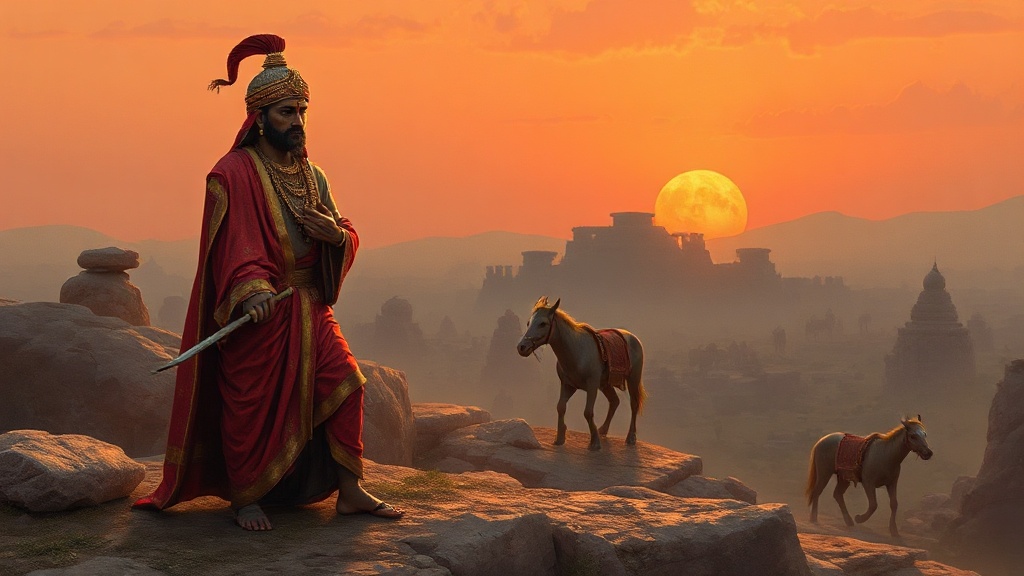
The figure of Chanakya, the architect of the Mauryan Empire and minister to Chandragupta Maurya, looms large in Indian historical tradition. Revered as a sagacious statesman, economist, and strategist, his influence is primarily documented in the Arthashastra, a text attributed to him. However, the precise origins of this pivotal historical figure remain a subject of considerable scholarly inquiry and debate, with various hypotheses emerging from linguistic, textual, and geographical evidence.
The name "Chanakya" itself offers a starting point for investigation. It is commonly understood to derive from "Chanak," believed to be his father's name. Yet, this parentage is not universally accepted or definitively proven. A more complex layer is added by the epithet "Kautilya," frequently associated with him, which some scholars interpret as denoting descent from a sage named Kushilya. This linguistic nuance is significant. The Sanskrit word gotra refers to a patrilineal lineage or clan. If "Kautilya" signifies a gotra affiliation, it could point towards a specific Brahmanical lineage rather than a direct familial tie. The Rigvedic suktas (hymns) mention a sage named Kushika, and some textual traditions link Kautilya to this ancient lineage. The Puranas, compendia of historical and mythological accounts, also offer genealogies that scholars scrutinize for clues. For instance, the Vishnu Purana traces Chandragupta's lineage to the Nandas, and Chanakya's to the line of Kushila. However, the precise identification and geographical placement of these lineages within the historical period of the Mauryan Empire are not always straightforward.
A key area of scholarly contention revolves around Chanakya's caste and geographical provenance. The Arthashastra itself provides internal clues, but their interpretation is debated. Some scholars posit that Chanakya was a Brahman, a member of the priestly class. This is often inferred from his profound knowledge of Vedic texts and his role as a political and economic theorist, domains typically associated with Brahmanical scholarship. The Mudrarakshasa, a Sanskrit play by Vishakhadatta, depicts Chanakya as a Brahman who experiences humiliation at the hands of the Nanda king, leading him to engineer the downfall of the Nanda dynasty and the rise of Chandragupta. However, the dramatic license employed in literary works necessitates careful historical analysis.
Geographically, hypotheses place Chanakya in various regions of the Indian subcontinent. One prominent theory suggests a Gandhara origin. This is based on certain linguistic features and cultural references within the Arthashastra that scholars interpret as pointing to the northwest. The presence of terms and concepts that resonate with Gandharan administrative practices or social structures has been cited. Another theory posits a Magadha origin, aligning with the political heartland of the Mauryan Empire. The narrative of Chanakya's involvement in overthrowing the Nanda dynasty, who ruled from Magadha, lends credence to this perspective. Furthermore, textual traditions sometimes associate him with the region around Pataliputra, the Mauryan capital.
The complexity intensifies when considering the term "Chanakya" itself. Some scholars propose it may be a prakritized form or a regional variant, potentially indicating a non-Sanskritized background or a geographical distinction. The Prakrit languages were vernacular forms of speech, distinct from the classical Sanskrit, and their usage varied across different regions and social strata. The presence of certain words or grammatical structures in texts attributed to or referencing Chanakya has led some linguists to explore potential connections to specific Prakrit dialects, which in turn can hint at geographical origins.
Moreover, the very nature of the Arthashastra has led some researchers to question a singular identity for its author. The text is vast and comprehensive, covering statecraft, economics, and military strategy. Some scholars suggest that it may represent a compilation of knowledge over time, with different sections reflecting varying intellectual traditions and geographical influences, rather than the singular output of one individual. If this is the case, then the "Chanakya" figure might be a composite, an embodiment of a learned tradition rather than a specific historical person with a singular ethnic and geographical background.
The scarcity of contemporary, non-literary evidence presents a significant challenge. Archaeological findings from the Mauryan period offer insights into the empire's administration and society, but direct references to Chanakya's personal origins are absent. Epigraphic evidence, such as edicts from Ashoka, primarily focuses on his reign and policies, not the lineage of his predecessors' ministers. Therefore, scholars must rely on the interpretation of textual traditions and linguistic analysis, often leading to competing hypotheses rather than definitive conclusions. The scholarly debate on Chanakya's origins underscores the intricate task of reconstructing ancient history from fragmented and often allegorical sources. It highlights how even the identity of foundational figures can remain open to rigorous academic interpretation.