Beyond the Maharajas: Unearthing North Indian History in the Margins
A fresh look at North Indian history moves beyond dominant narratives, exploring how linguistic analysis and textual evidence can reveal the lives and contributions of lesser-known figures and regional communities.
Asha Naidu for SwavedaJuly 10, 2026
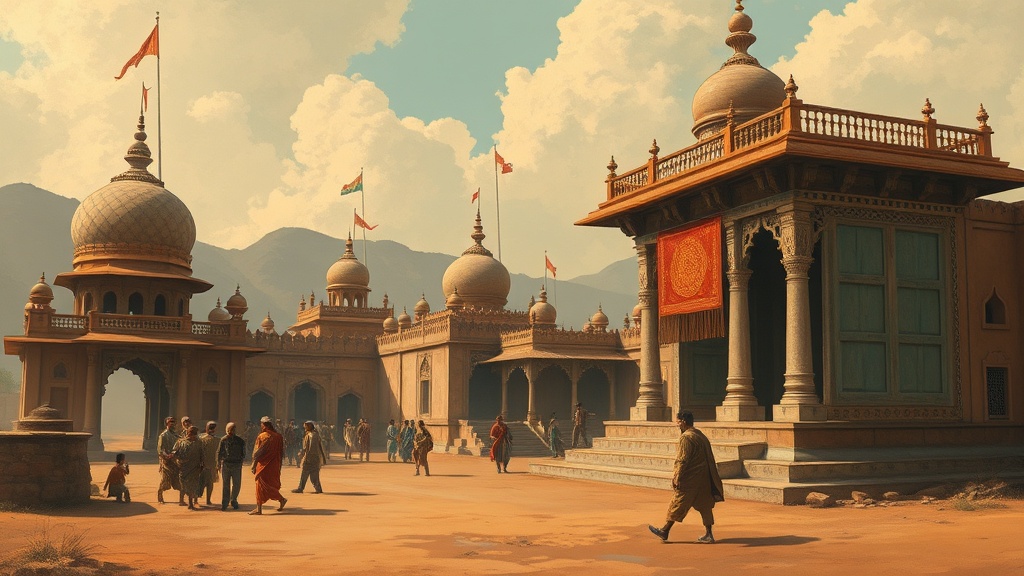
The history of North India is often told through the grand sweep of empires and the pronouncements of kings. We learn of Ashoka's vast dominion, the Gupta golden age, or the Mughal splendor. These narratives, while important, can obscure the complex tapestry of life for the majority of the population. They often focus on the apex of power, leaving the foundations and the surrounding lands in shadow.
This focus on prominent rulers and expansive kingdoms presents a significant historiographical challenge. It risks presenting a monolithic view of the past, one where regional variations and the contributions of non-elite groups are overlooked. The challenge for scholars is to reconstruct a more nuanced understanding of North Indian history by actively seeking out and integrating the stories of these often-marginalized figures and communities.
One path toward this more inclusive history lies in careful linguistic analysis. Words are not merely tools for communication; they carry echoes of past societies, their interactions, and their beliefs. The very etymology of words—their origin and evolution—can offer clues to historical processes. Consider the word "grama" (ग्राम), commonly translated as "village." Its presence in early Sanskrit texts points to a fundamental unit of social and economic organization that predates larger political entities. The persistence of this term and its variations across numerous regional languages in North India suggests a deep historical continuity of village-based life, even as larger kingdoms rose and fell.
Beyond common terms, the study of local dialects and the vocabulary specific to particular regions can reveal unique historical experiences. For instance, specialized terms related to agriculture, craft production, or local governance found in inscriptions or regional literature can illuminate economic practices and social structures that might not be mentioned in pan-Indian chronicles. The presence of loanwords from different languages within a regional dialect can also indicate historical contact and exchange with other cultures.
Textual evidence, beyond royal edicts and epic poems, is also crucial. This includes a wide range of materials such as temple inscriptions, land grants, merchant records, and even folk tales. These sources, often discovered in local archives or as archaeological finds, provide glimpses into the lives of individuals who were not rulers or elite courtiers.
For example, land grants, often issued by local chieftains or wealthy landowners, can reveal the names of donors, recipients, and witnesses. These individuals, though not kings, were key players in the local economy and social fabric. Their activities, such as the endowment of temples or the provision of land for agriculturalists, shaped the development of specific regions. The language used in these grants, the specific terms for land ownership and taxation, and the religious affiliations mentioned can all contribute to our understanding of regional power dynamics and social hierarchies.
Archaeological discoveries further complement textual evidence. Excavations at smaller settlements, often overlooked in favor of major capital cities, can reveal the material culture of everyday life. The discovery of pottery styles, tools, and housing patterns at these sites allows scholars to infer social stratification, economic activities, and cultural practices of the people who lived there. When these findings can be correlated with linguistic data or textual mentions of specific settlements, a more robust picture emerges.
The integration of these diverse forms of evidence is what allows scholars to move beyond the "grand narratives." It is a process of piecing together fragmented information to reconstruct the experiences of a broader spectrum of people. This is not about diminishing the importance of major dynasties, but about enriching our understanding by acknowledging that history is made not only by those at the top but also by the countless individuals who formed the bedrock of society.
Scholars debate the precise methods for integrating these disparate sources. Some emphasize the primacy of linguistic reconstruction, arguing that language change is a fundamental indicator of population movement and cultural interaction. Others prioritize the careful translation and interpretation of local administrative and economic records, believing these offer the most direct insight into social structures. Still others focus on the granular details revealed by archaeology, suggesting that material culture provides an unfiltered view of daily life.
What unites these approaches is a commitment to a more grounded, evidence-based history. It requires a departure from reliance on a few well-known historical texts and a willingness to engage with a wider array of sources. This can be a painstaking process, often involving the study of obscure scripts, the decipherment of damaged inscriptions, and the cross-referencing of information from multiple, sometimes contradictory, sources.
The value of this endeavor is profound. By understanding the lives of regional communities and marginal figures, we gain a more accurate and comprehensive picture of North India's past. We see how diverse local traditions interacted, how economic activities were organized outside the purview of imperial control, and how cultural practices evolved in response to varied circumstances. This scholarly work, though less dramatic than accounts of battles and coronations, is essential for a true understanding of the region's deep and multifaceted history.