How Harappans Farmed: Wheat, Pulses, and the Tools Behind the Indus Valley's Grain Economy
Archaeobotanists studying seeds, phytoliths, and tool marks have rebuilt the Harappan farm calendar — what was planted when, and the tools that made a two-season harvest possible.

Kavya Sharma for SwavedaJuly 30, 2026
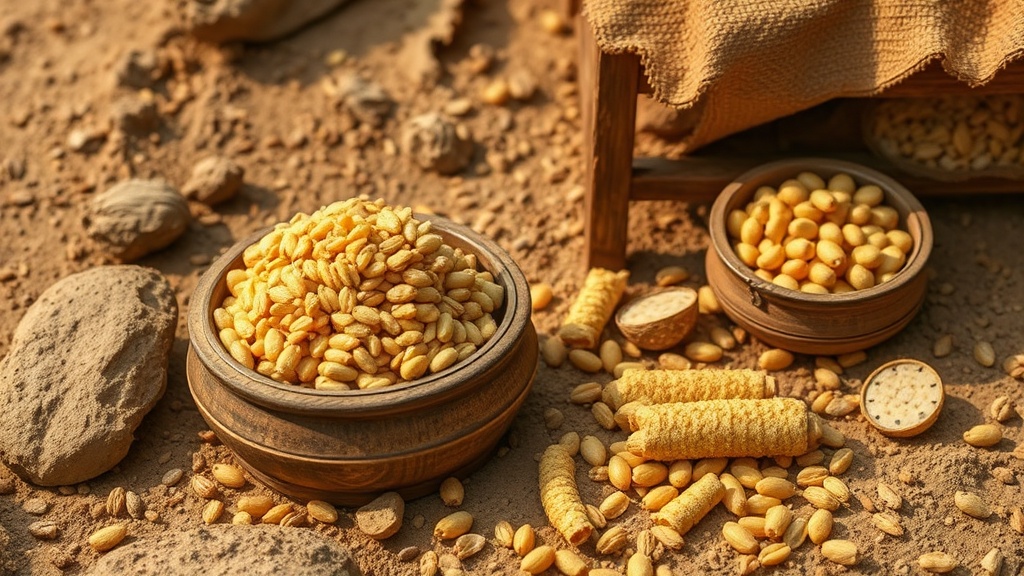
A farmer at Rakhigarhi five thousand years ago did not have one growing season to worry about. She had two — and she had to know exactly which seeds went into the ground for each. That calendar, pieced together from charred grain, silica plant residues, and the wear patterns on stone tools, is the real story buried under the bricks of the Indus Valley Civilisation. It is a story about farming methods first, and only afterward about food.
Two Seasons, One System
Traditional accounts of Harappan agriculture centered on a single winter harvest of wheat and barley, crops that depend on rain brought by winter storm systems from the west. Evidence now shows that picture was incomplete. Archaeobotanical analysis — the study of plant remains recovered from archaeological sites — has documented a second, summer-grown layer of agriculture running alongside it: foxtail millet, barnyard millet, and little millet, all of which mature quickly and tolerate far less water than wheat (Nature).
This was not an accident of climate. It was a deliberate hedge. If winter rains failed, the summer millet crop still came in. Researchers studying the Rakhigarhi material have linked the rise of this dual-cropping system to a period of shifting monsoon patterns across the Indus-Ghaggar-Hakra plains, arguing that Harappan farmers restructured their calendar in direct response to a less predictable water supply (Nature). Put simply: this was risk management, encoded in seed choice.
The Toolkit: Ploughs, Sickles, and Querns
None of this worked without hardware. Excavators at Indus Valley sites have long noted a recurring tool assemblage suited to exactly this kind of mixed farming: bone and antler points shaped for breaking soil, worked much like a ploughshare; stone and terracotta sickle-like blades for cutting cereal stalks close to harvest; and saddle querns — flat stone slabs paired with a hand-held grinding stone — for reducing grain to flour or meal. At Rakhigarhi, archaeologists have identified large circular platforms that appear to be communal grinding stations, suggesting grain processing was organized at a neighborhood scale rather than done privately in each home.
Furrow marks preserved in ploughed fields at Kalibangan, a site further along the Ghaggar-Hakra system, have been cited by researchers as some of the oldest physical evidence of ploughing anywhere in the world — a criss-cross pattern that matches the spacing still used in parts of northwest India for intercropping two species in the same field. That detail matters for the question of tools: a field ploughed in two directions implies two different crops sown together, not a single monoculture. It's a farming decision, not a coincidence of soil erosion.
Grinding stones, sickle blades, and storage structures at Harappa and Mohenjo-daro follow a similar pattern to what's documented at Rakhigarhi, though the level of published archaeobotanical detail varies by site — Rakhigarhi currently has the most granular seed and phytolith record available in peer-reviewed literature. Tradition holds that Mohenjo-daro's famous "granary" structure stored surplus grain for the city; scholars debate how centralized that storage system actually was, since no charred grain deposit large enough to confirm state-run stockpiling has been definitively recovered there.
Reading the Fields Through Phytoliths
Much of this reconstruction rests on phytoliths — microscopic silica structures that form inside plant tissue and survive long after the organic material has decayed. When researchers examine phytolith samples from Indus Valley agricultural contexts, they find a consistent signature of mixed cropping rather than a single dominant grain. That pattern, combined with the seed record, tells archaeologists that Harappan farmers were not applying one technique across the landscape. They were reading local soil and water conditions and adjusting the mix — wheat and barley where winter rain was reliable, drought-tolerant millets where it wasn't, and pulses layered in wherever nitrogen-poor soil needed a boost.
What the Harvest Fed
All of this agronomic decision-making eventually turns into an evening meal, and here the picture gets domestic. Millets, unlike wheat, are poorly suited to bread-making — they were more likely boiled into a porridge or cooked in earthen pots. Charring patterns on the bases of ceramic vessels recovered from Indus Valley sites are consistent with slow-cooking over open fires, the kind of preparation suited to grains and pulses rather than fast-baked bread (Journal of Archaeological Science).
Farming, though, was never the whole story of the plate. Wild legumes and fruit remains turn up consistently alongside the cultivated grain in excavation layers, and pulses like horse gram and green gram appear to have supplemented the diet even inside dense urban centers. Scholars debate how much of this represents genuine foraging versus small-scale kitchen-garden cultivation, but either way, it points to a food system that never depended on a single crop.
Farming as Infrastructure
Step back from the seeds and the sickles, and what emerges is a civilization that treated agriculture the way it treated its drainage channels and its brick platforms — as infrastructure, engineered and maintained. The Harappan farm calendar wasn't a fixed inheritance handed down from earlier foragers. It was actively redesigned, season by season, to match a landscape that kept changing under its feet. That, more than any granary wall, is what let cities like Rakhigarhi last for centuries.