Before the Sufis: Animal Piety and the Beast-Ascetics of the Pali Canon
An analysis of the Bhūridatta Jātaka reveals how early Buddhist texts granted spiritual agency and ritual capacity to non-human animals long before medieval traditions.

Meera Iyer for SwavedaAugust 6, 2026
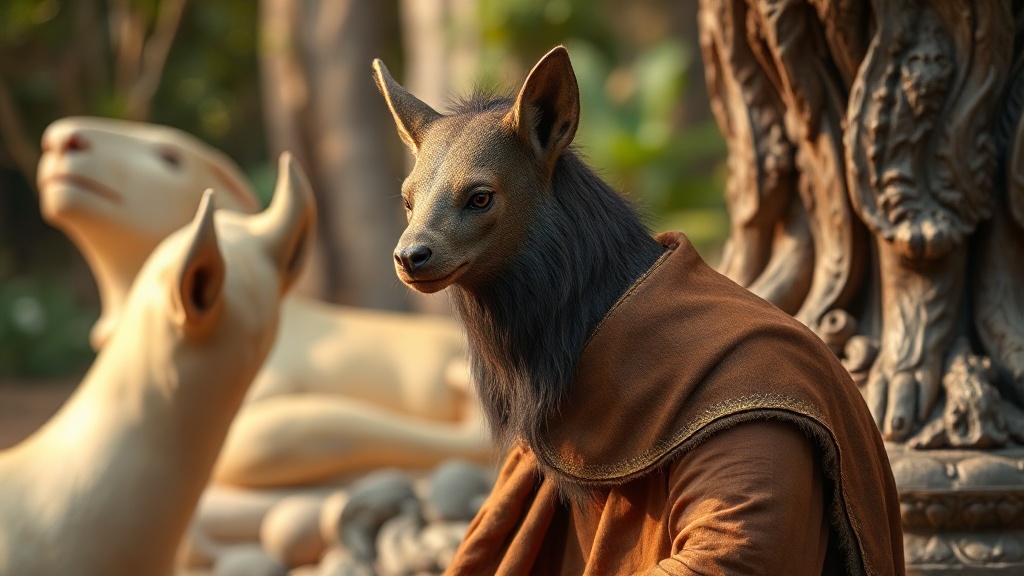
Medieval Sufi traditions in South Asia famously describe animals as conscious beings capable of divine worship. However, an older tradition of animal piety exists within the Pali Canon, the standard collection of scriptures in the Theravada Buddhist tradition. Recent philological analysis of the Bhūridatta Jātaka (the birth story of the Buddha as a serpent king) challenges modern assumptions about when Indian literature first granted spiritual agency and ritual capacity to non-human animals.
In Buddhist narrative literature, the transition from beast to ascetic is not merely symbolic. It is governed by a strict adherence to vatta (monastic or religious duty), a Pali term corresponding to the Sanskrit vrata (vow or religious observance). Scholars tracking these texts have noted that early Buddhist writers did not view animals as spiritually inert actors waiting for a human rebirth. Instead, these texts depict animals as active participants in the path to liberation through physical self-mortification and ritual vows.
Decoding the Snake-Ascetic: The Bhūridatta Jātaka
The fifth passage of the Bhūridatta Jātaka contains a detailed description of the protagonist, Bhūridatta, who is a nāga (serpent or semi-divine snake deity). Dissatisfied with the sensory pleasures of his subterranean kingdom, Bhūridatta ascends to the human realm to find an ant-hill where he can perform his religious vows.
The Pali text describes his vow in precise terms:
Cāturaddhikaṃ uposathaṃ upavasāmīti (IAST: Cāturaddhikaṃ uposathaṃ upavasāmīti) "I observe the four-part sabbath."
The compound cāturaddhikaṃ (consisting of four parts) refers to the division of the uposatha (sabbath or day of observance) into specific quarters of the lunar month. What makes this passage philologically significant is the subsequent description of his physical posture. Bhūridatta coils his body around the ant-hill, declaring that anyone who wishes to take his skin, muscles, or bones may do so.
Traditional commentators often view this as a simple act of charity. However, a closer reading of the compound guṇavatta (the virtue of religious duty) in the verses reveals a different conceptual framework. The snake is not merely acting as a passive donor. He is actively performing a vatta (ritual duty) that requires conscious control over his animal instincts.
The Linguistic Mechanics of Vatta
In Sanskrit and Pali philology, the word vatta (Sanskrit: vṛtta or vrata, depending on context) carries a double meaning. It can refer to standard conduct, or it can denote a highly restricted ascetic vow. In the Bhūridatta Jātaka, the term is used to establish a parallel between the behavior of human forest-dwelling ascetics and the behavior of wild beasts.
For instance, the text uses the compound valmīka-sirasi (on the head of the ant-hill) to locate the snake's ascetic seat. In ancient Indian ascetical practice, the valmīka (ant-hill) was associated with earth, moisture, and the gateway to the underworld. By coiling on the valmīka, the animal occupies a space that is literally and symbolically intermediate between the subterranean world of instinct and the celestial world of the gods.
A paper published in the Bulletin of the School of Oriental and African Studies examines how these early Buddhist texts handle the tension between animal form and ascetic discipline. The analysis demonstrates that the Pali text does not treat Bhūridatta’s animal form as a barrier to high-level spiritual practice. Instead, his serpentine body becomes the very instrument through which the vatta (vow) is realized. His coils mimic the seated posture of a meditating human sage.
Challenging the Human-Centric Hierarchy
Evidence from these primary texts shows that early Buddhist writers worked within a cosmology where the boundary between human and animal capability was porous. While classical Brahmanical texts like the Manusmṛti (Laws of Manu) generally restrict the performance of vrata (vows) to twice-born human males, the Pali Jātakas open these practices to the animal kingdom.
The Bhūridatta Jātaka does not present this animal piety as an anomaly. Throughout the text, other forest creatures observe the snake's devotion and react with quiet reverence. The text notes that even the potaka (young birds or small animals) in the surrounding forest cease their noise when Bhūridatta sits in meditation. This collective quietude transforms the wild forest into a tapovana (penance grove), a space defined by the mutual suspension of predatory behavior.
This linguistic and narrative evidence shows that the concept of non-human piety was well-developed in India centuries before the arrival of Sufi mystical poetry. While Sufi stories emphasize the ecstatic, emotional devotion of animals toward a singular Creator, the Pali Jātakas emphasize a different model: the systematic, disciplined mastery of the animal body through formal vows. The beast-ascetic of the Pali Canon is not merely a metaphor for human struggle; he is a legitimate practitioner of the path to cessation.